
The AI-native job description
The state of AI in US marketing, content, and GTM job ads, 2024 to 2026
A research report by AI Native Marketing · November 2026 · 43 min read
A note before you read

I've built and led marketing teams, and I've written more job descriptions than I care to admit. For most of that time, the tools section at the bottom of the ad was boilerplate. Microsoft Office, Google Workspace, maybe HubSpot or Salesforce if the hiring manager was feeling specific. Nobody read it, including the people who wrote it.
That section is where this report started. Sometime in the past year, AI stopped being a line you could skip. It moved up the ad, into the responsibilities and the qualifications, and it changed shape on the way. "Familiarity with ChatGPT" turned into "You've built AI workflows, with examples of what they changed."
I wanted to know how far that had gone, so we counted. We pulled every US marketing, content, sales, and GTM operations job ad we could get from the same four weeks in 2024, 2025, and 2026, then read 1,905 of them line by line. The short answer: AI is now named in more marketing job ads than Google Workspace, and the ads that ask for it are asking for something much more specific than they were a year ago.
This report is the long answer. Use it to write better job ads, to plan your team, or to decide what to learn next. Every number in it comes from the data described in the method section or from a named public source, linked on the claim.
Stefan Maritz, AI Native Marketing
Executive summary
AI has become a standard requirement in US marketing, content, and go-to-market (GTM) job ads in the space of two years. Between 16 October and 14 November 2026, 14.8% of US marketing job ads asked for AI skills by name, up from 0.8% in the same weeks of 2024. In content marketing roles the share was 31.2%, almost one in three, in GTM operations 22.4%, and in sales 6.8%.
The clearest marker of the change is the tools section. In 2024, 0.4% of US marketing ads named an AI tool such as ChatGPT or Claude, against 2.1% that named Google Workspace. In 2026 it was 5.1% against 3.0%. The crossover happened between our 2025 and 2026 windows in marketing, sales, and GTM operations, and a year earlier in content.
Most of these mentions describe the job. When we read the ads, about three in four AI mentions sat in the qualifications or the responsibilities, and one in five ads listed AI as a qualification. About 13% made it a hard requirement.
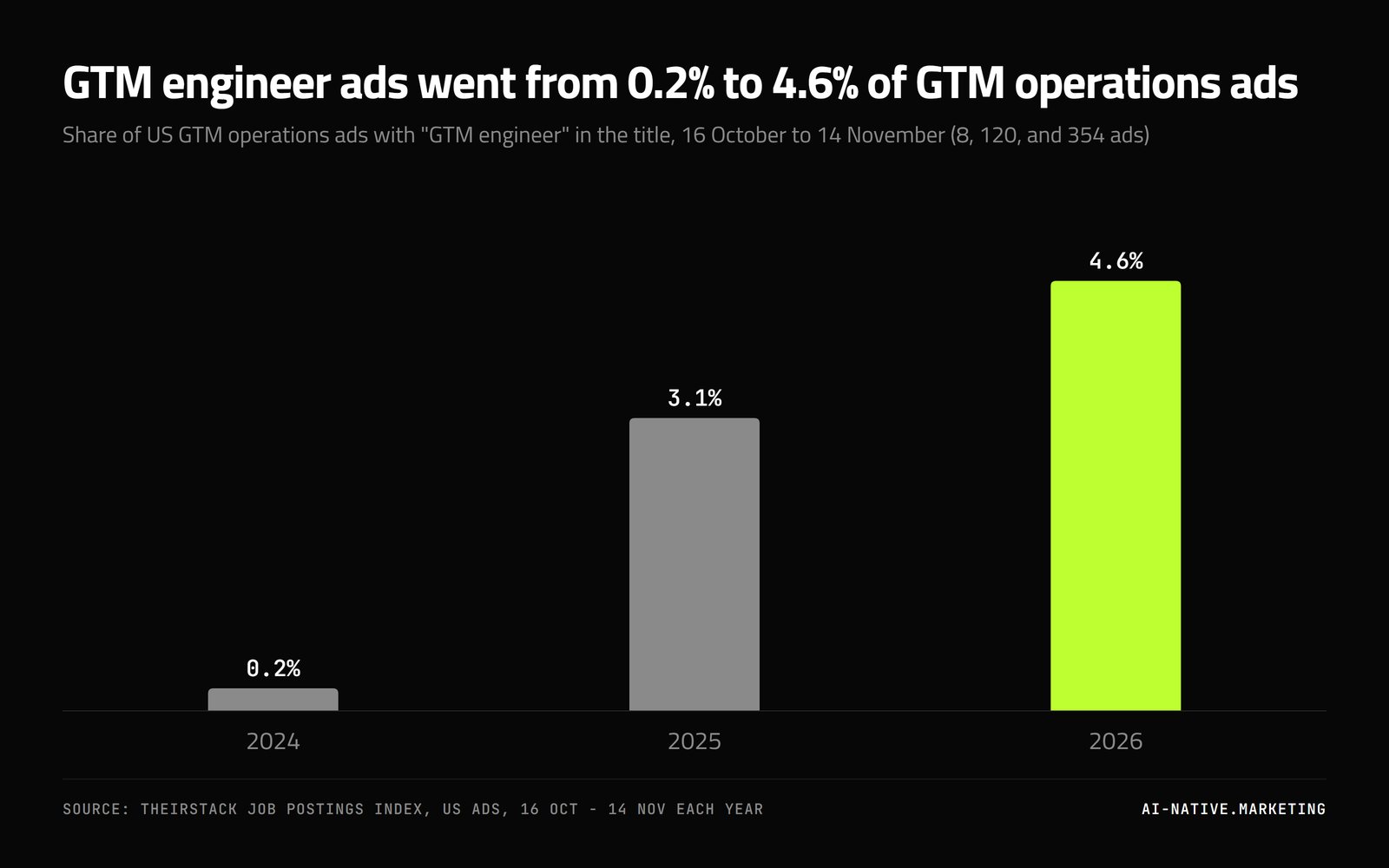
The requirement has also changed shape. Tool fluency is still the most common ask, but employers increasingly want people who build with AI: agents, automated workflows, and systems built in tools like Clay, n8n, Zapier, and Claude Code. In GTM roles more than a third of AI-asking ads want a builder, and ads with "GTM engineer" in the title went from 0.2% to 4.6% of GTM operations ads between 2024 and 2026.
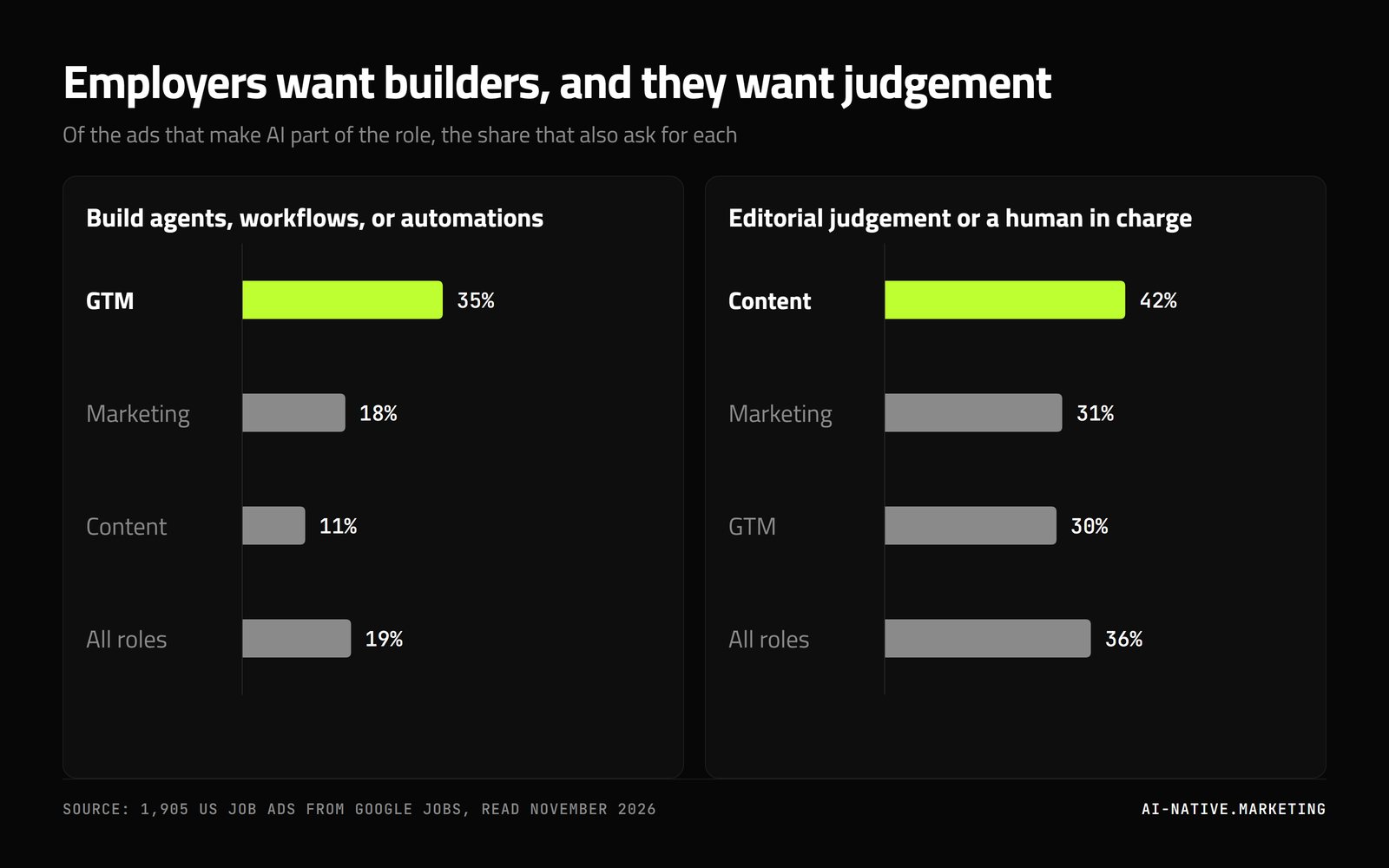
Employers pair the AI requirement with judgement. More than a third of the ads that put AI in the role also ask for quality control, editorial judgement, accuracy, or a human who owns the final output. In content roles it's 42%.
Junior roles get asked least. In the ads we read, 13% of entry-level roles put AI in the job, against 31% of mid-level, 41% of senior, and 31% of leadership roles. Remote roles ask more often than on-site ones, at 41% against 28%.
Claude, Anthropic's AI model, overtook ChatGPT as the most-named AI tool in marketing and content job ads in 2026. The single-purpose AI marketing tools of 2023, like Jasper and Midjourney, barely appear.
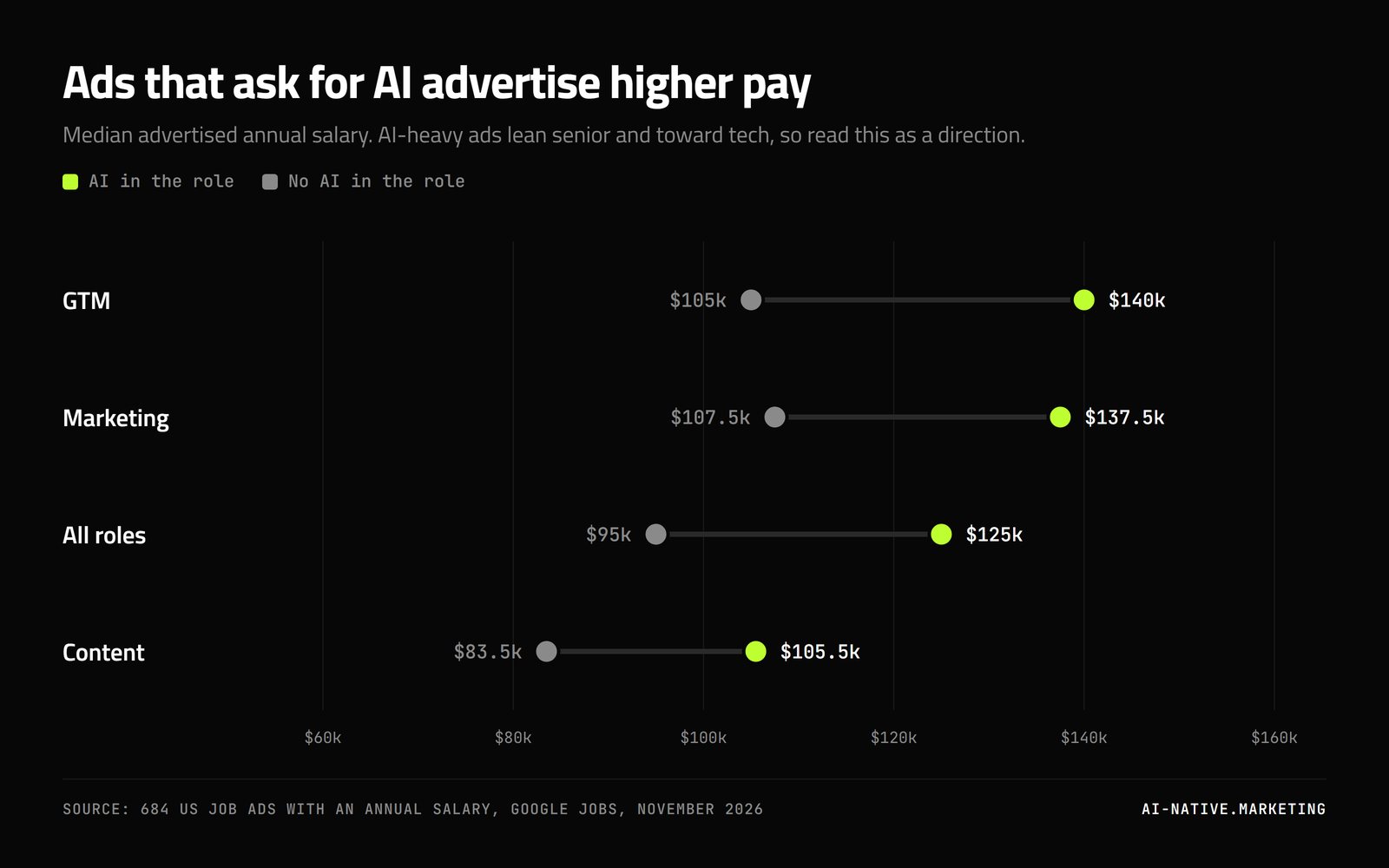
Ads that put AI in the role advertise higher pay: a median of $125,000 against $95,000 for ads without it. Compared like for like, at the same seniority level or inside the same job title, the premium is $18,500 to $23,500, or roughly 20%. It's largest mid-career, and it's largest of all for builders, whose ads advertise a median of $143,500.
The pattern lines up with the largest labour market datasets. Marketing job postings on LinkedIn requiring AI literacy more than doubled in a year, up 113%, AI mentions in US marketing postings on Indeed rose from 8.4% to 14.9% during 2025, and across the whole US economy, 2.5% of job postings mention AI skills. Marketing sits far above that line.
AI is on the same road Google Workspace travelled. First a skill employers list, then a skill they assume. In marketing, content, and GTM, we're past the halfway point.
Ten findings at a glance
- AI tools passed Google Workspace. 5.1% of US marketing ads name an AI tool, against 3.0% for Google Workspace. In 2024 the figures were 0.4% and 2.1%.
- AI skill asks grew 18 times in two years in marketing. From 0.8% of ads in 2024 to 14.8% in 2026. Content reached 31.2%, GTM operations 22.4%, and sales 6.8%.
- The climb was steady, quarter after quarter. On our broader measure of AI-skills language, the share of US marketing ads went from 1.5% in the first quarter of 2025 to 15.7% in the autumn of 2026, a tenfold rise in seven quarters.
- One in five ads screens on AI. 20% list AI under qualifications and 13% make it a hard requirement.
- Tool fluency is the floor, and judgement is the most common pairing. 44% of AI-asking ads want tool fluency, and 36% pair AI with quality, judgement, or human ownership.
- Claude overtook ChatGPT. Claude appears in 3.2% of marketing ads and ChatGPT in 2.3%. A year earlier ChatGPT led by more than four to one.
- Juniors get asked least, senior roles most. AI is part of the job in 13% of entry-level ads, 31% of mid-level, 41% of senior, and 31% of leadership ads.
- Remote roles ask more. 41% of remote ads put AI in the job, against 28% of on-site ads.
- Builders are the new premium. "GTM engineer" ads went from 0.2% to 4.6% of GTM operations ads in two years, and 35% of AI-asking GTM ads want someone who builds agents or automations.
- AI roles advertise more, and builders most. The median advertised salary is $125,000 where AI is part of the role and $95,000 where it isn't. Like for like, the premium is about 20%, and ads that ask you to build with AI advertise a median of $143,500.
About this research
We built this report from two data sets, both limited to job ads posted in the United States.
The index. We queried TheirStack's job postings index, which collects ads from company career sites and job boards and removes duplicates. We counted ads by job title and by the words in the description, and we ran every count over the same four-week window, 16 October to 14 November, in 2024, 2025, and 2026. Using the same weeks each year removes seasonality from the comparison. In the 2026 window alone the index held 41,734 marketing ads, 3,571 content marketing ads, 71,265 sales ads, and 7,733 GTM operations ads. We added quarterly counts for 2025 and 2026, and cuts by seniority, company size, and remote work. In total we ran 208 counts.
The reading sample. We pulled 2,136 US job ads from Google Jobs across 39 job titles, removed duplicates by title and company, and kept 1,905. Google Jobs splits most ads into qualifications, responsibilities, and benefits. That split lets us tell the difference between "you need this skill" and "we're an AI-powered company", which a keyword count can't.
The role groups.
- Marketing: any title that contains "marketing". This includes content marketing, product marketing, demand generation, growth, brand, and field marketing.
- Content: content marketing, content strategy, content writing, copywriting, head of content, managing editor, and SEO content roles.
- Sales: account executives, sales development and business development representatives, and sales managers, directors, and VPs.
- GTM operations: revenue operations, marketing operations, sales operations, GTM engineers, and other go-to-market roles.
The term groups.
- AI mentioned: "AI", "artificial intelligence", "GenAI", "generative AI", and "LLM".
- AI tools named: ChatGPT, Claude, Gemini, Copilot, Perplexity, Jasper, and Midjourney.
- AI skills: phrases that ask for a capability: "AI tools", "AI-powered tools", "generative AI tools", "AI fluency", "AI literacy", "AI proficiency", "AI workflows", "AI-assisted", "experience using AI", "experience with AI", "prompt engineering", "prompting", "AI-driven tools", and "AI automation". We tested this list on the ads we read: 80% of its matches sit in the duties or qualifications.
- Broad AI-skills language: our first, wider list, which also counted "AI agents", "agentic", "AI-native", "AI-first", and "AI platforms". Those phrases often describe the company instead of the job, so only 71% of its matches sit in the role. We use it only for the quarterly trend and the company-size cut, which a provider outage stopped us from re-running on the stricter list. In marketing, the two measures stayed within 6% to 14% of each other in every year we checked, so the trends hold and the levels run slightly high.
- Google Workspace: Google Workspace, G Suite, and Google Docs, Sheets, and Slides.
- AEO: answer engine optimisation, generative engine optimisation, AEO, GEO, AI search, AI Overviews, and LLM visibility.
The full method, including its limits, is at the end of the report. The short version: job ads show what employers ask for, which isn't the same as who they hire or how the work gets done. We compare shares across years and never raw volumes, because the index grows every year.
AI passed Google Workspace

AI tools are now named in more US marketing job ads than Google Workspace. In our 2026 window, 5.1% of marketing ads named at least one AI tool and 3.0% named Google Workspace or one of its apps.
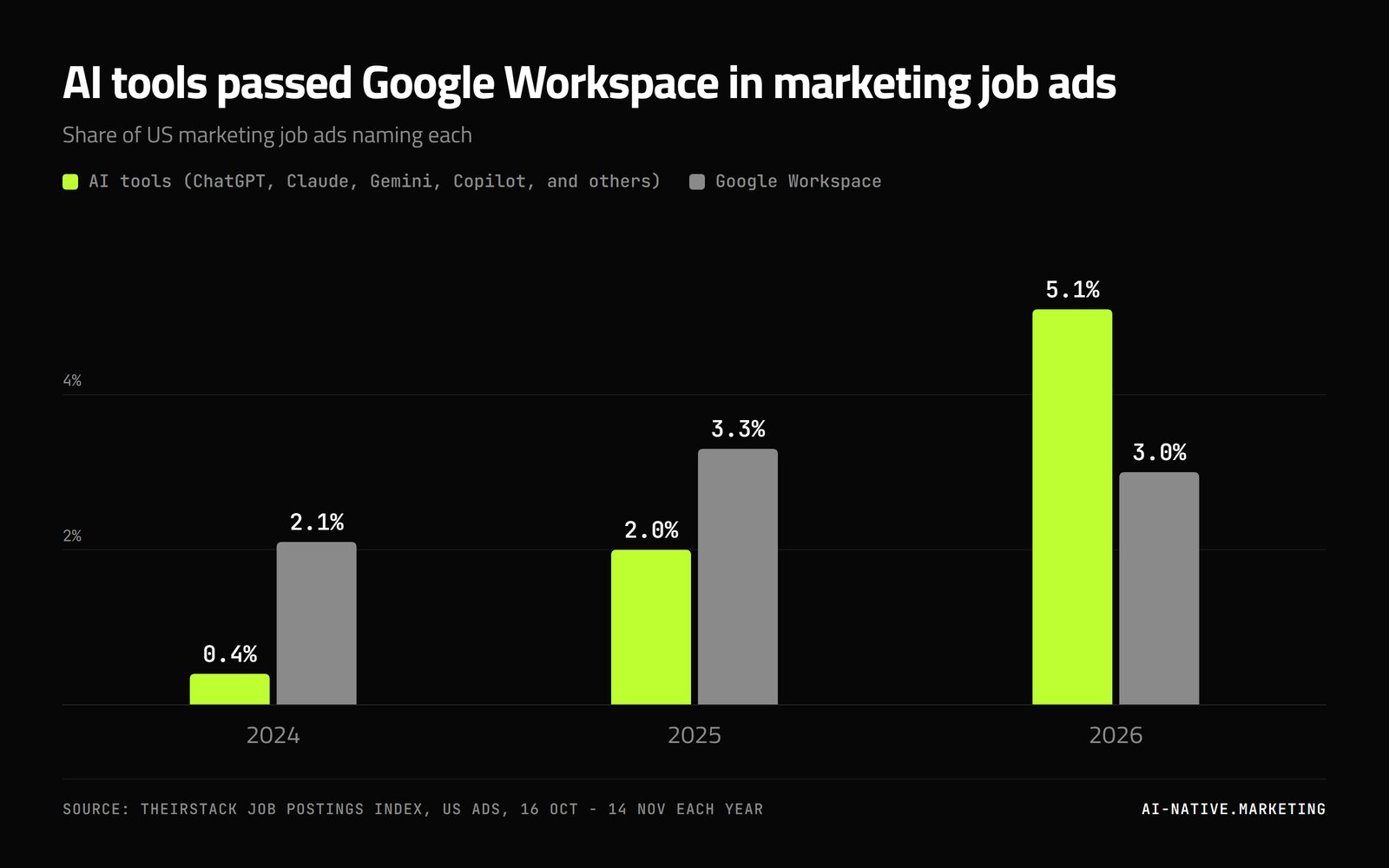
Two years earlier the order was the other way round. In October and November 2024, Google Workspace showed up in 2.1% of marketing ads and AI tools in 0.4%. By 2025 the gap had narrowed to 3.3% against 2.0%. In 2026 AI tools pulled ahead.
The crossover happened in every group we measured.
| 2026 | AI tools named | Google Workspace named | AI mentioned at all |
|---|---|---|---|
| Content | 8.6% | 3.7% | 53.0% |
| GTM operations | 10.0% | 6.3% | 53.9% |
| Marketing | 5.1% | 3.0% | 32.5% |
| Sales | 1.6% | 1.3% | 26.0% |
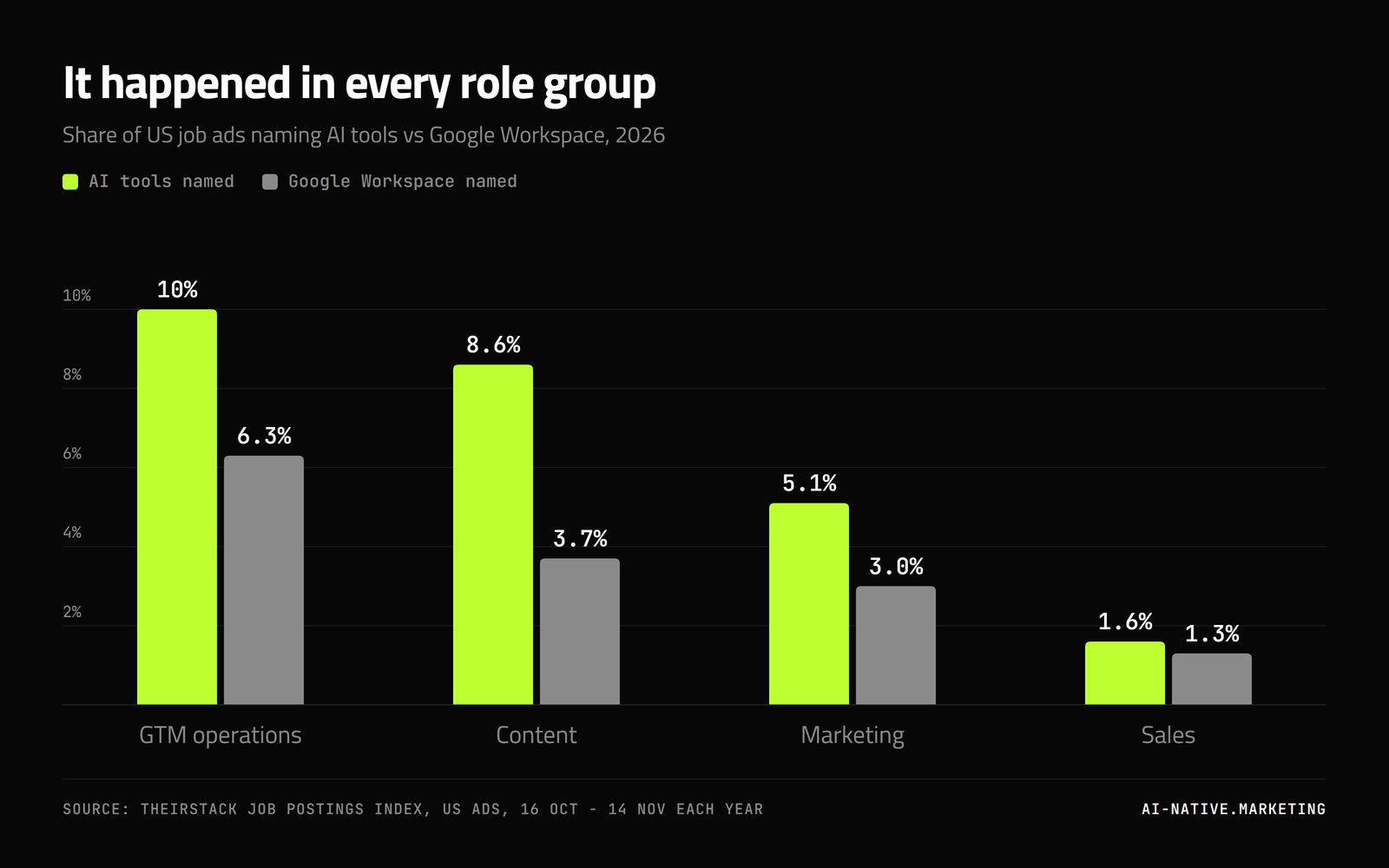
Content roles got there first. In 2025, content ads already named AI tools more often than Google Workspace, at 6.0% against 4.2%. GTM operations crossed in 2026 with the biggest margin of any group, and even sales, where AI tools appear in only 1.6% of ads, now edges past Google Workspace.
Why Google Workspace is the right yardstick
Google Workspace is a useful comparison because it's the definition of an assumed skill. Employers rarely write "must be able to use Google Docs", for the same reason they don't write "must be able to send an email". When they do name it, it's usually in the tools line near the bottom of the ad.
AI is on the same road. A skill starts as a differentiator that employers spell out, becomes a requirement they list, and ends as an assumption they stop writing down. Google Workspace is at the end of that road. In marketing job ads, AI has passed the point where it was a novelty and is now named more often than one of the most common pieces of office software in the world.
Two caveats keep the comparison fair. Excel still appears in more marketing ads than any single AI tool, at 15.8%. And because employers under-name Google Workspace, the crossover says more about how visible AI has become than about which tool people use more.
AI against the whole office suite
Count AI as a category, and it beats the whole Microsoft Office family too. 32.5% of US marketing ads mention AI somewhere, against 25.9% that mention Microsoft Office, Excel, PowerPoint, or Microsoft 365.
| 2026 share of ads | AI mentioned | Microsoft Office family | HubSpot or Salesforce |
|---|---|---|---|
| Content | 53.0% | 15.1% | 7.6% |
| GTM operations | 53.9% | 30.8% | 37.7% |
| Marketing | 32.5% | 25.9% | 15.1% |
| Sales | 26.0% | 27.0% | 23.3% |
Sales is the one group where Office still leads, by a single point. In content and GTM operations, AI shows up in more than half of all ads, well ahead of every other tool family.
How this fits the wider market
Other large datasets point the same way, at different levels because they count different words. AI mentions in US marketing postings on Indeed rose from 8.4% at the start of 2025 to 14.9% by the end of December, against a high of 4.2% across all US postings. Jobs on LinkedIn requiring AI literacy skills grew 70% in a year, and marketing job postings requiring AI literacy grew 113%, faster than the market as a whole.
Marketing is one of the functions where AI requirements are moving fastest. Our data shows where inside marketing, and what exactly employers are asking for.
The two-year climb

The share of US marketing job ads asking for AI skills grew 18 times in two years, from 0.8% in our 2024 window to 14.8% in 2026. Every group we measured moved by a similar order of magnitude.
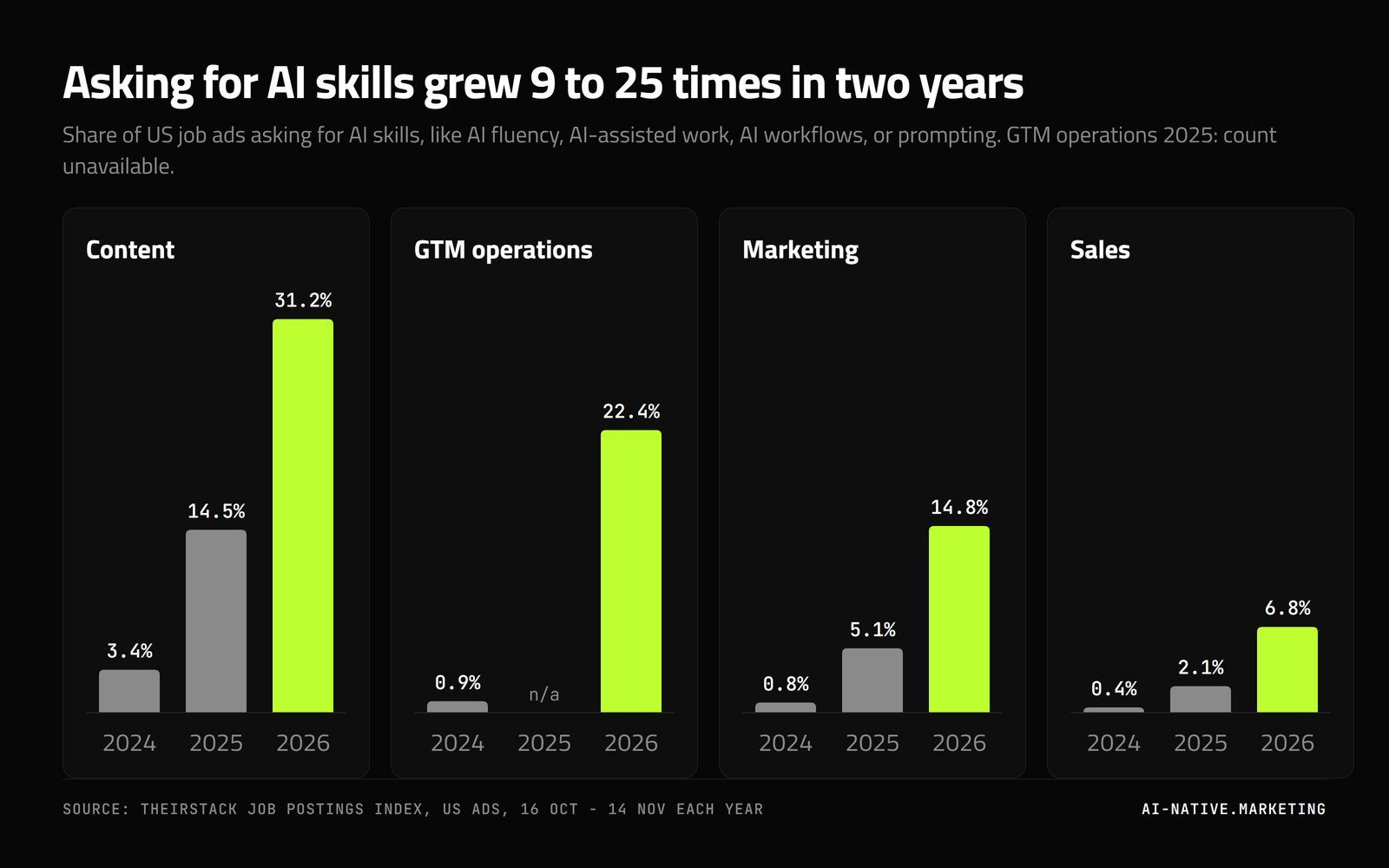
| Ads asking for AI skills | 2024 | 2025 | 2026 | Growth |
|---|---|---|---|---|
| Content | 3.4% | 14.5% | 31.2% | 9x |
| GTM operations | 0.9% | n/a | 22.4% | 25x |
| Marketing | 0.8% | 5.1% | 14.8% | 18x |
| Sales | 0.4% | 2.1% | 6.8% | 17x |
The 2025 GTM operations count failed at the data provider, so that cell is empty.
Content started earliest, so its growth multiple looks the smallest, and it now leads by a distance: almost one in three content ads asks for AI skills. GTM operations grew fastest, from under 1% to more than one in five, which chapter 7 explains.
Quarter by quarter
The rise wasn't a single jump. We counted US marketing and content ads with AI-skills language in every quarter from January 2025 to mid-November 2026, and the share climbed in all but one of them. This series uses our broader measure, which runs about 10% above the stricter one in marketing, so read it for the shape of the trend.
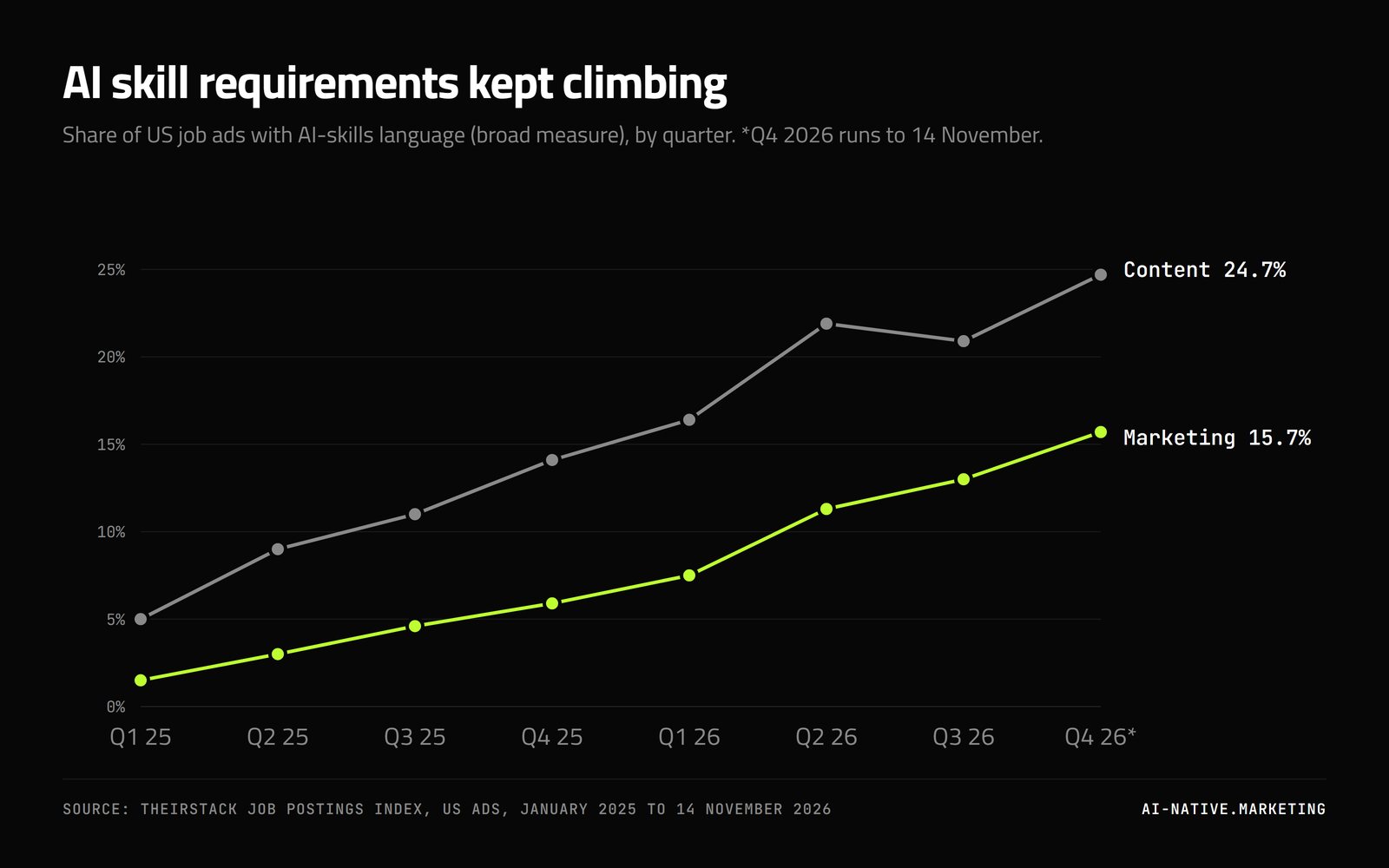
| Ads with AI-skills language (broad measure) | Marketing | Content |
|---|---|---|
| Q1 2025 | 1.5% | 5.0% |
| Q2 2025 | 3.0% | 9.0% |
| Q3 2025 | 4.6% | 11.0% |
| Q4 2025 | 5.9% | 14.1% |
| Q1 2026 | 7.5% | 16.4% |
| Q2 2026 | 11.3% | 21.9% |
| Q3 2026 | 13.0% | 20.9% |
| Q4 2026 (to 14 November) | 15.7% | 24.7% |
Marketing went up tenfold in seven quarters. The steepest step came in the second quarter of 2026, when the share jumped from 7.5% to 11.3%. Content dipped by a point in the third quarter of 2026 and then hit a new high in the autumn.
The volume of ads adds context. Marketing ads in the index fell through 2025, from about 117,000 in the first quarter to about 80,000 in the fourth, then recovered to about 118,000 in the third quarter of 2026. AI requirements kept climbing through both the dip and the recovery. Employers who were hiring less still added AI to the ads they did post.
Mentions, named tools, and skills
The three AI measures grew at different speeds, and the order tells a story.
| Marketing ads | 2024 | 2025 | 2026 |
|---|---|---|---|
| AI mentioned anywhere | 6.8% | 16.7% | 32.5% |
| AI skills asked for | 0.8% | 5.1% | 14.8% |
| AI tools named | 0.4% | 2.0% | 5.1% |
Mentions came first, as companies described themselves as AI-powered. Skill requirements followed and grew fastest. Named tools grew too, but stayed the smallest measure. Employers care more about the capability than the brand of tool, a point we come back to in chapter 5.
Job titles with AI in them
AI has also started to show up in job titles. Ads with titles such as "AI marketing manager", "AI content strategist", or "AI product marketing manager" went from 0.9% of marketing ad volume in our 2024 window to 1.4% in 2025 and 2.7% in 2026 (321, 381, and 1,145 ads).
Some of those roles market AI products, rather than use AI to do the marketing. Even so, the jump between 2025 and 2026 is the largest of the three years, and the "AI marketing manager" title had the highest AI requirement rate of any title in our reading sample. Three in four of those ads put AI in the job itself.
Requirement or boilerplate?

Most AI mentions in US marketing, content, and GTM job ads describe the job. When we read 1,905 ads and separated the qualifications and responsibilities from the rest, about three in four AI mentions sat inside the role.
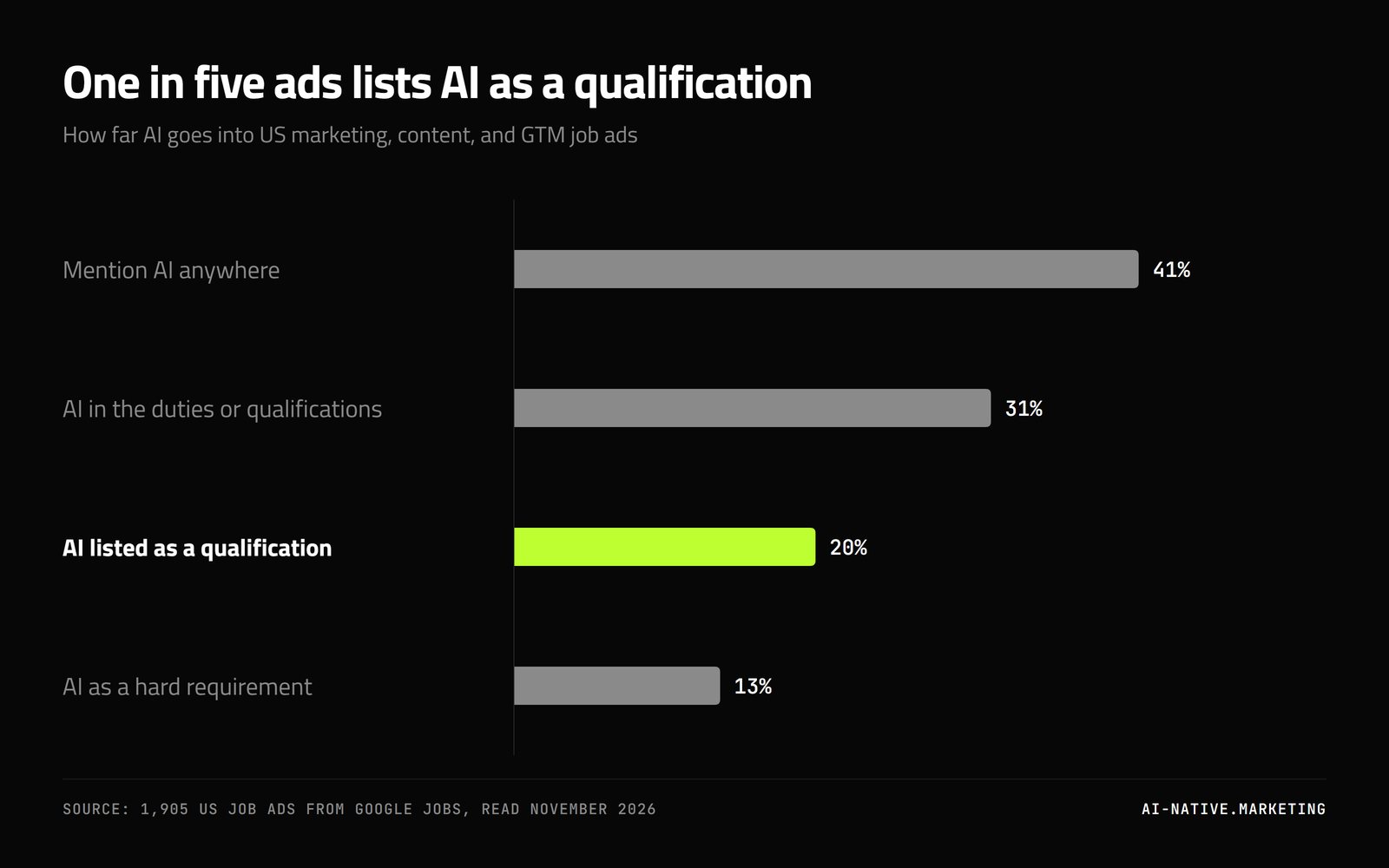
The breakdown across the whole sample:
- 41% of ads mention AI anywhere.
- 31% put AI in the qualifications or the responsibilities.
- 20% list AI under qualifications.
- 13% list it as a straight requirement, with no "preferred", "a plus", or "familiarity with" softener.
- 6% list it as a bonus.
The remaining 10% mention AI only in the company description, the product pitch, or the benefits. A lot of US companies now describe themselves as AI-powered, and those mentions say nothing about the job. They're why we report the stricter figures next to the broad ones.
The rate holds across groups
| Reading sample | Content | Marketing | GTM |
|---|---|---|---|
| Ads in the sample | 895 | 550 | 460 |
| AI mentioned anywhere | 38% | 45% | 42% |
| AI in duties or qualifications | 31% | 32% | 31% |
| AI listed as a qualification | 19% | 20% | 21% |
| AI as a hard requirement | 12% | 14% | 16% |
The near-identical rates across very different jobs are the most striking part of this table. A copywriter, a product marketing manager, and a revenue operations lead now face roughly the same odds of an AI screen. GTM is a touch stricter, with 16% of ads making AI a hard requirement.
What a hard requirement looks like
The softer asks read like a nudge: "an interest in applying AI", "curiosity about AI and automation", "familiarity with AI tools is a plus". The hard ones read like a screen:
Practical experience using AI tools (e.g., ChatGPT, Claude) for work tasks.
URBN, UX content strategist
Experience leveraging AI tools to improve marketing performance and efficiency.
Acrisure, demand generation manager
Skills in prompting AI systems and assessing output quality.
Kofax, senior sales account executive
Hands-on experience setting up, running, and evaluating AI agents in production GTM environments.
Monday.com, GTM engineer
The direction of travel is clear. Two years ago the softer phrasing dominated what little AI language there was. In 2026, more than one in eight ads makes it a must-have.
What employers mean by "AI skills"

"AI skills" covers at least eight different requirements, and employers in different functions mean very different things by it. We sorted every AI-related qualification and responsibility in our reading sample into categories, based on what the line asks the candidate to do.
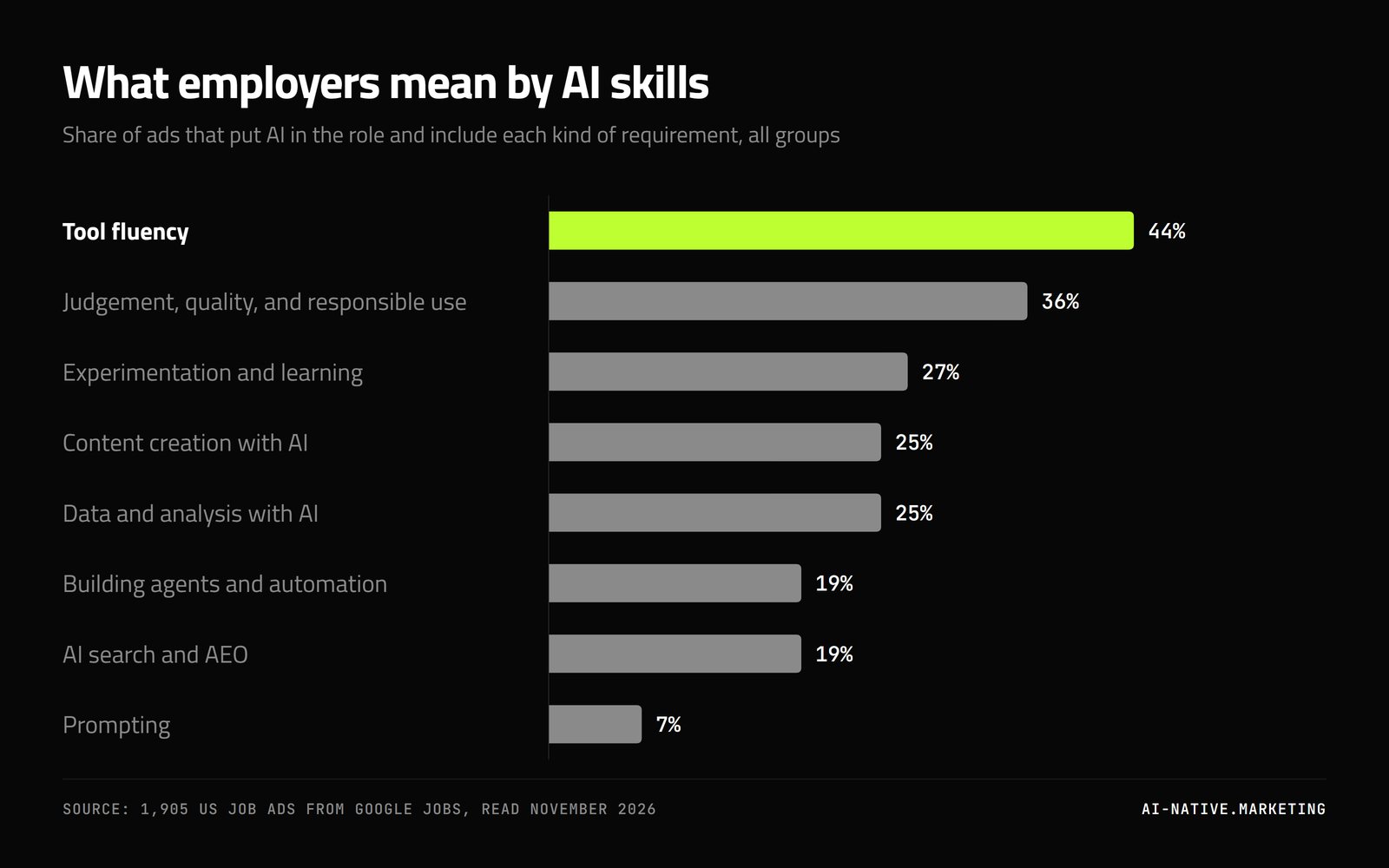
Share of ads that put AI in the role and include each kind of requirement (one ad can include several):
| Kind of AI requirement | All | Content | Marketing | GTM |
|---|---|---|---|---|
| Tool fluency | 44% | 46% | 45% | 41% |
| Judgement, quality, and responsible use | 36% | 42% | 31% | 30% |
| Experimentation and learning | 27% | 31% | 24% | 22% |
| Content creation with AI | 25% | 40% | 19% | 3% |
| Data and analysis with AI | 25% | 23% | 26% | 26% |
| Building agents and automation | 19% | 11% | 18% | 35% |
| AI search and AEO | 19% | 36% | 6% | 1% |
| Prompting | 7% | 10% | 3% | 7% |
Tool fluency is the floor
Tool fluency is the most common ask in every group, at 41% to 46%. These lines ask candidates to be comfortable with AI tools as part of daily work: "fluent with AI tools like Claude, ChatGPT, and Gemini as part of your day-to-day workflow" (BreachLock), or "comfortable learning and using new tools quickly, including AI tools like Claude" (Kikoff). It's the baseline, the AI equivalent of "proficient in Microsoft Office".
Prompting is fading as a named skill
Prompting appears in only 7% of AI-asking ads. In 2023, prompt engineering was the AI skill people put on their CVs. In 2026 employers barely name it, and when they do, it tends to sit inside a broader ask, such as "prompting AI systems and assessing output quality". The skill hasn't gone away. It's been absorbed into tool fluency, the same way nobody lists "can write a search query" as a skill any more.
Each function has its own AI job
The categories split sharply by function, and the split matches the work.
- Content roles want AI for creation (40%), for AI search and answer engine optimisation (36%), and with judgement attached (42%).
- Marketing roles spread their asks evenly, with the most weight on tool fluency and on data and analysis (26%).
- GTM roles want builders. 35% of AI-asking GTM ads want someone who builds agents or automations, against 11% in content. AI content creation barely appears (3%).
Keep this in mind when you write a job ad or plan your development. "AI skills" on a content marketer's ad and "AI skills" on a GTM engineer's ad describe two different jobs.
The learning ask
27% of AI-asking ads ask for curiosity, experimentation, or a habit of learning: "driven to stay ahead of industry trends, including actively learning how AI and automation can enhance marketing and operations" (Directive). Employers know the tools will change before the next hire is up to speed, so they're hiring for the ability to keep up as much as for what candidates know today.
The tools employers name

Claude, Anthropic's AI model, is now the most-named AI tool in US marketing and content job ads. In our 2026 window, Claude appeared in 3.2% of marketing ads and ChatGPT in 2.3%. In content ads it was 6.4% against 5.1%.
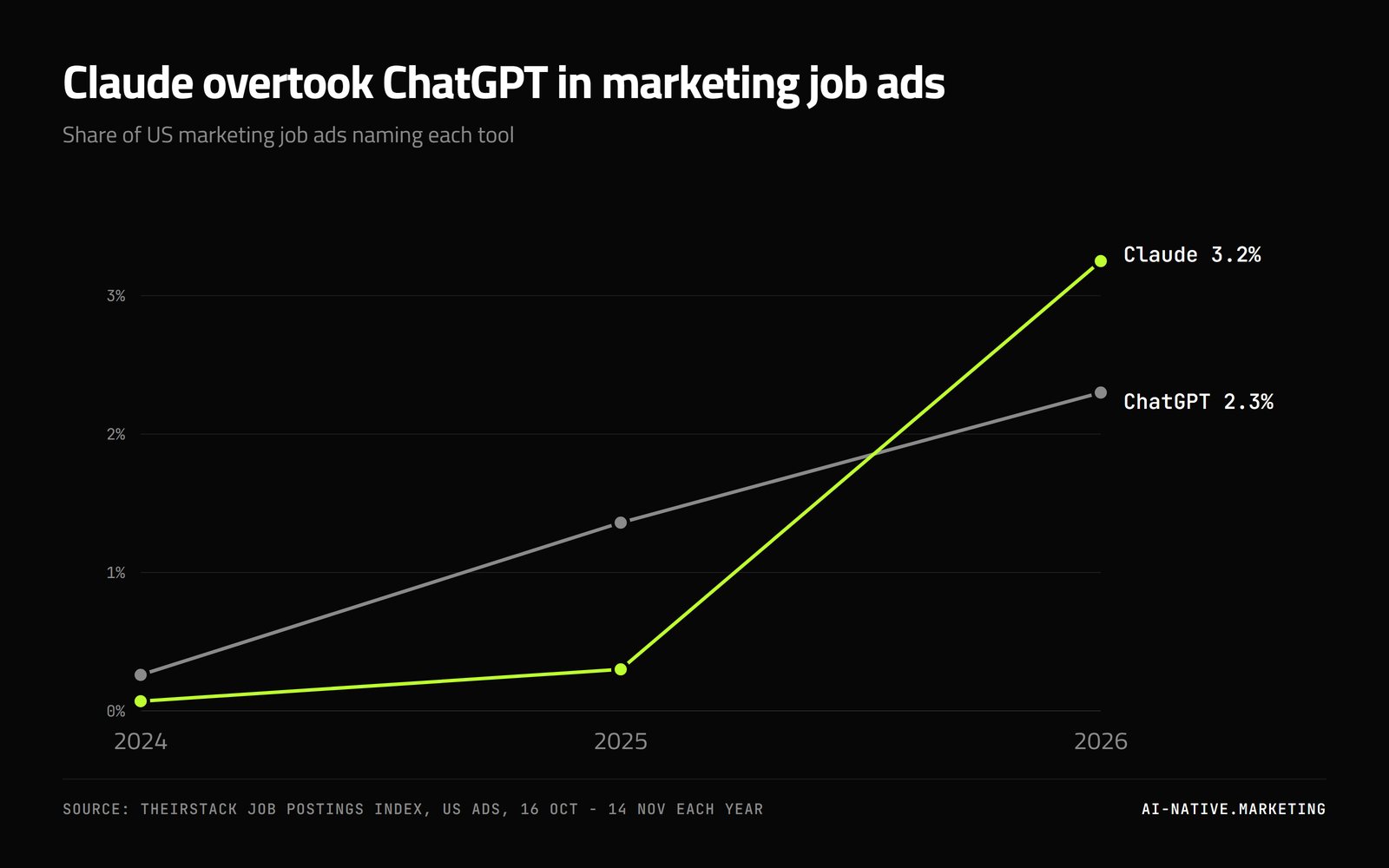
The flip happened fast. In our 2025 window ChatGPT appeared in 1.36% of marketing ads and Claude in 0.30%, a lead of more than four to one. Twelve months later Claude led. Content ads followed the same path, from ChatGPT leading 5.0% to 0.9% in 2025 to Claude leading 6.4% to 5.1% in 2026.
We checked the Claude mentions by hand, because Claude is also a first name. They hold up. Ads say things like "AI productivity tools such as ChatGPT or Claude" (Wpromote), "You will use AI tools, including Claude, in your own work" (Fivetran), and "Build workflows that take one brief to hundreds of on-brand variants, using Claude" (Vibe.co). Our reading sample agrees on the order, with Claude in 4.6% of ads and ChatGPT in 4.5%.
The point tools faded
| Tool named | Marketing ads, 2026 | Content ads, 2026 |
|---|---|---|
| Claude | 3.2% | 6.4% |
| ChatGPT | 2.3% | 5.1% |
| Copilot | 1.3% | 1.1% |
| Gemini | 0.7% | 2.0% |
| Perplexity | 0.4% | 1.3% |
| Jasper | 0.1% | 0.5% |
| Midjourney | 0.1% | 0.3% |
Jasper and Midjourney were the faces of AI marketing in 2023. In 2026 they appear in roughly one marketing ad in 1,000. Employers name the general-purpose models and expect candidates to bend them to the task, rather than hire for a specific AI copywriting or image tool.
The stack stayed
AI joined the marketing stack without pushing anything out.
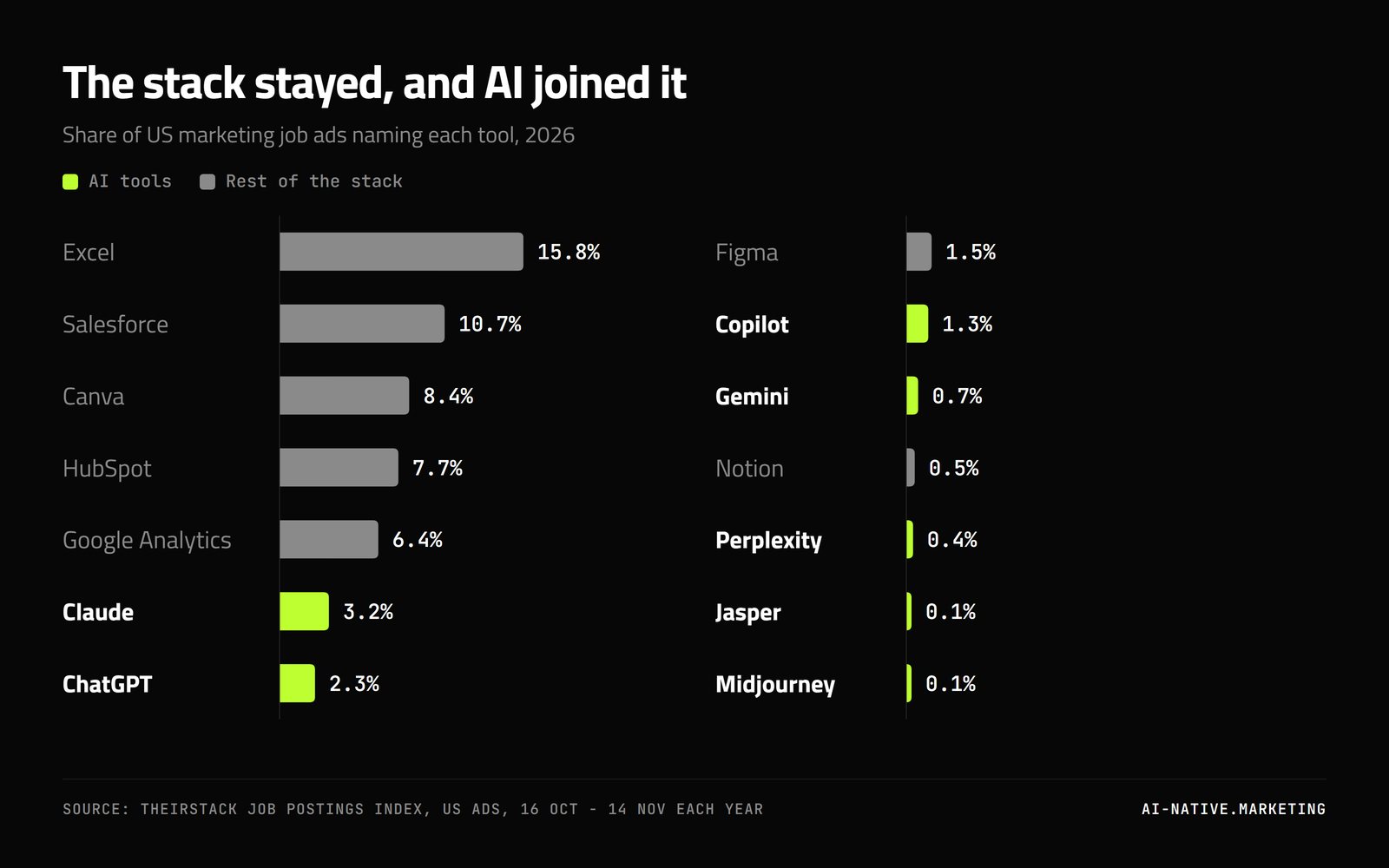
Excel (15.8%), Salesforce (10.7%), Canva (8.4%), HubSpot (7.7%), and Google Analytics (6.4%) all still appear in more marketing ads than any AI tool. In content ads, Canva is the most-named tool of all at 10.5%, ahead of Excel at 8.0% and Claude at 6.4%.
Marketers aren't trading their stack for AI. They're expected to run both, and to connect them, which is where the builder tools in chapter 7 come in.
How this lines up with what marketers report
Survey data shows marketers already use AI widely, which helps explain why employers now write it down. 75% of marketers have adopted AI in Salesforce's survey of 4,450 marketing decision makers, and 66% of marketers globally use AI in their roles in HubSpot's survey of more than 1,000 marketing professionals. Hiring is catching up with practice. When most of a team already uses a tool, the next hire is expected to arrive knowing it.
Who gets asked

AI requirements aren't spread evenly. They depend on seniority, company size, whether the role is remote, and above all the job title.
Juniors get asked least, senior roles most
AI expectations climb with seniority and peak at senior level. In the 1,905 ads we read, AI was part of the job in 13% of entry-level ads, 31% of mid-level ads, 41% of senior ads, and 31% of leadership ads. We sorted ads into levels by the words in their titles, and we counted AI only where it appears in the qualifications or responsibilities, so company descriptions can't inflate these numbers.
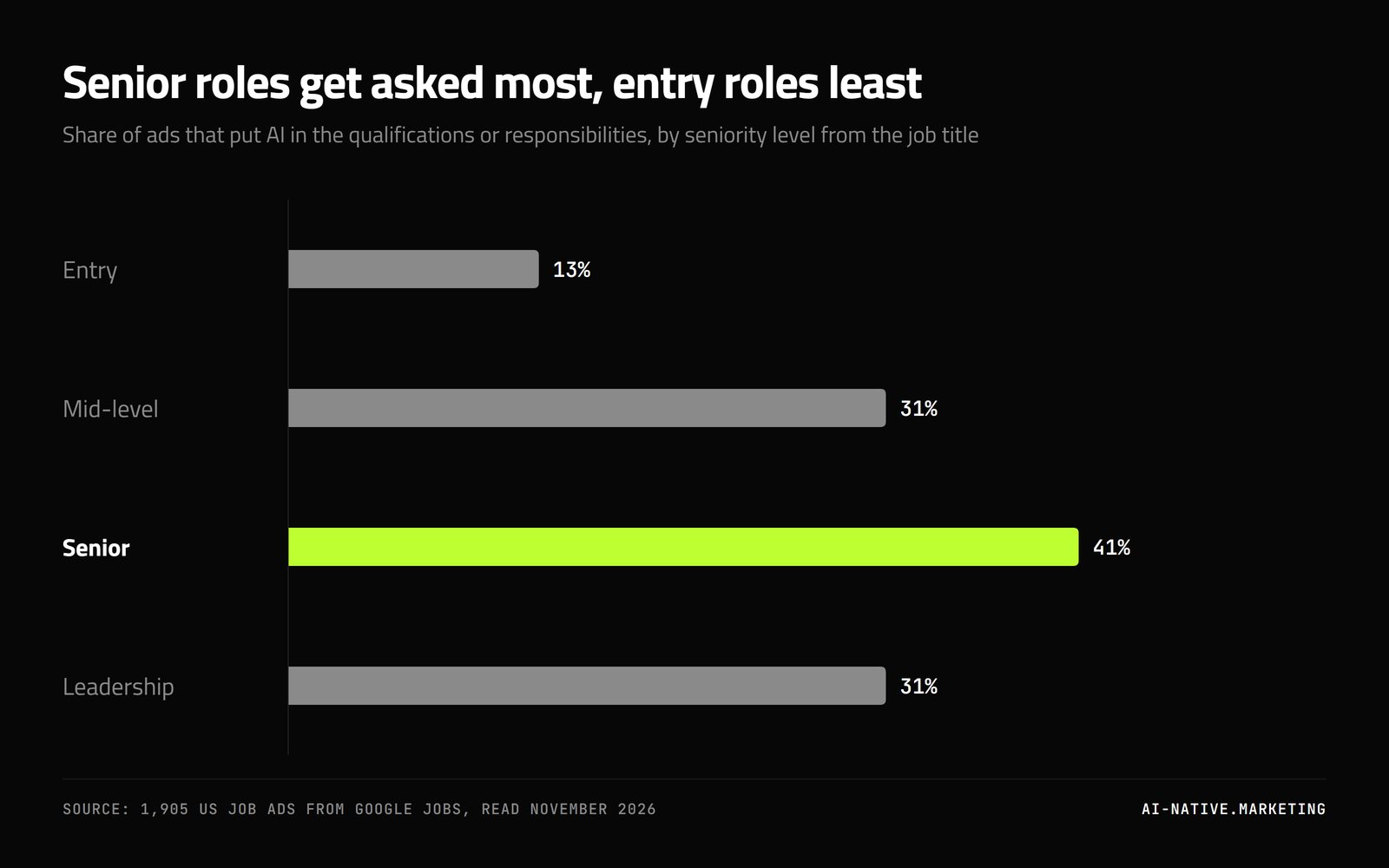
| Seniority level | Ads read | AI in the role |
|---|---|---|
| Entry (coordinator, associate, junior) | 141 | 13% |
| Mid-level | 1,268 | 31% |
| Senior (senior, lead, principal) | 311 | 41% |
| Leadership (head, director, VP) | 185 | 31% |
The pattern runs against the popular story that AI hits junior roles first. In the ads, AI is an expectation of the people who run the work: decide where it goes, set the standards, and own the output. One director of content marketing ad, at Fivetran, asks for "hands-on fluency with AI tools in content work, and clear views on where people must stay in charge."
The job index shows the same ordering at the bottom of the ladder. On our broader measure, 7.5% of junior marketing ads use AI-skills language, against 19.7% of senior ones. The index also put C-level ads highest, at 28.2%, but that measure counts company descriptions like "AI-first", which top-level ads use often, and the ads we read show leadership roles level with mid-level ones.
The expectation matches what executives say in surveys. In Microsoft's 2024 Work Trend Index, two-thirds of leaders (66%) said they wouldn't hire someone without AI skills. In 2025, 78% of leaders said they were considering hiring for new AI roles. The people setting those expectations are writing them into the ads for the roles directly below them.
Mid-size companies ask most
| Marketing ads, 2026, by company size | Ads | AI-skills language (broad measure) |
|---|---|---|
| 1 to 50 employees | 6,351 | 17.7% |
| 51 to 500 employees | 8,374 | 20.2% |
| 501 to 5,000 employees | 8,438 | 18.9% |
| More than 5,000 employees | 10,475 | 14.7% |
Companies with 51 to 500 employees use AI-skills language most often, and the largest enterprises least. Big companies tend to centralise AI in dedicated teams and platforms, while smaller teams need every marketer to carry it themselves. A five-person marketing team can't hand AI to someone else.
Remote roles ask more
Remote roles put AI in the job more often. In the ads we read, 41% of remote ads put AI in the qualifications or responsibilities, against 28% of on-site ads. The gap is widest in GTM (48% against 28%) and content (42% against 27%), and small in marketing (35% against 31%).
Remote teams tend to be more tool-heavy and more written, and they lean on asynchronous work that AI speeds up. The job index points the same way for marketing on the broader measure, with 27.6% of remote marketing ads using AI-skills language against 16.4% overall, though that measure also picks up remote-first AI start-ups describing themselves.
Job titles tell the sharpest story
Title by title, the share of ads in our reading sample that put AI in the role ranges from three in four down to less than one in 10.
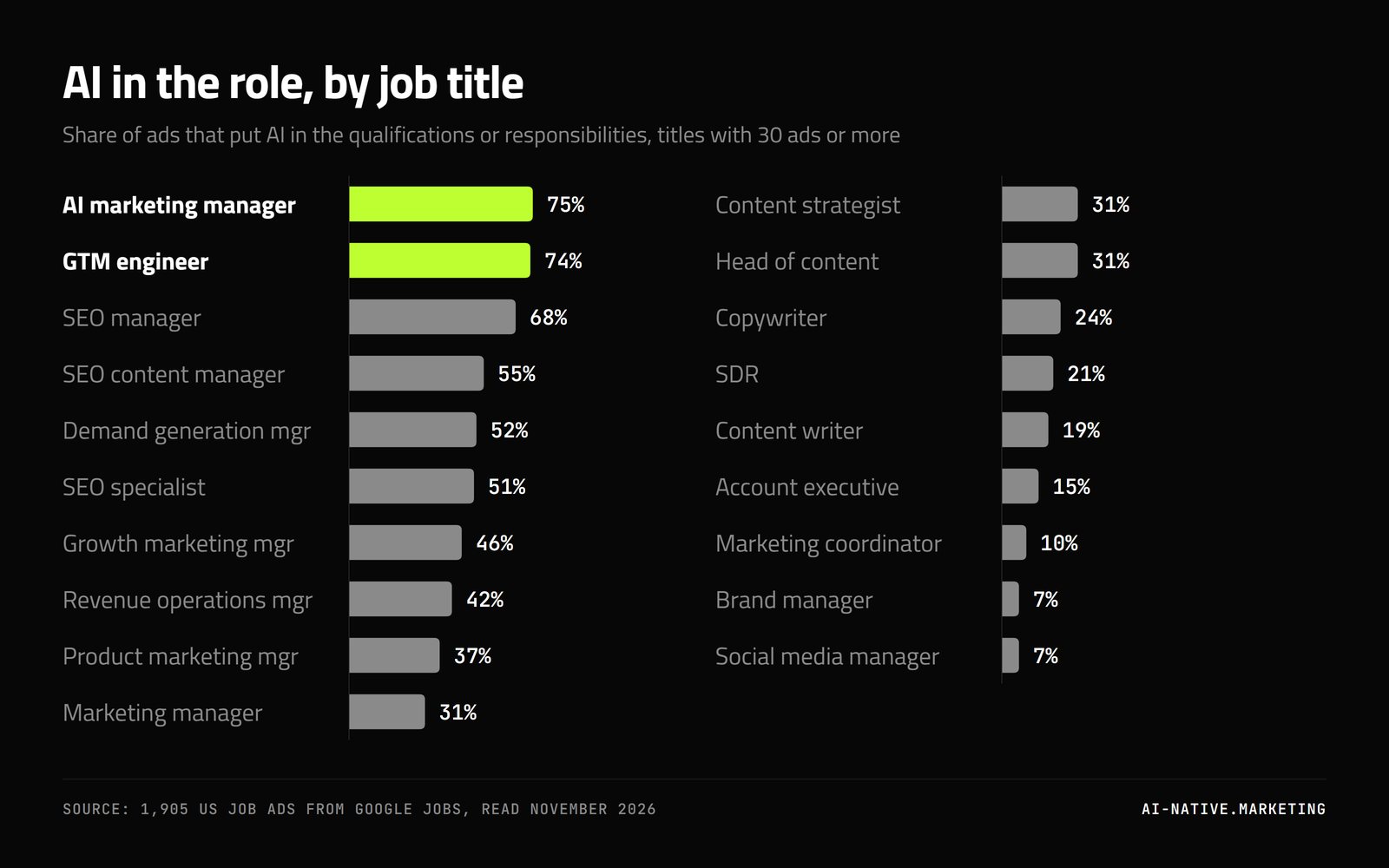
| Job title (30 ads or more) | Ads read | AI in the role |
|---|---|---|
| AI marketing manager | 40 | 75% |
| GTM engineer | 66 | 74% |
| SEO manager | 62 | 68% |
| SEO content manager | 76 | 55% |
| Demand generation manager | 62 | 52% |
| SEO specialist | 45 | 51% |
| Growth marketing manager | 48 | 46% |
| Revenue operations manager | 69 | 42% |
| Product marketing manager | 57 | 37% |
| Marketing manager | 64 | 31% |
| Content strategist | 88 | 31% |
| Head of content | 72 | 31% |
| Copywriter | 86 | 24% |
| Sales development representative | 72 | 21% |
| Content writer | 84 | 19% |
| Account executive | 54 | 15% |
| Marketing coordinator | 61 | 10% |
| Brand manager | 54 | 7% |
| Social media manager | 61 | 7% |
SEO roles stand out. Two in three SEO manager ads put AI in the role, driven by the shift to AI search covered in chapter 10. Demand generation and growth roles follow, where AI runs through campaign operations and analysis. At the other end, brand managers and social media managers are rarely asked for AI in writing, which says more about how those ads are written than about how those jobs are done.
From using AI to building with it

The fastest-growing AI requirement is for people who build with AI. In our reading sample, 19% of ads that put AI in the role want someone who builds agents, automated workflows, or AI systems. In GTM roles it's 35%.
The GTM engineer
The clearest sign is a job title that barely existed two years ago. US ads with "GTM engineer" in the title went from 0.2% of GTM operations ads in our 2024 window to 3.1% in 2025 and 4.6% in 2026, or from eight ads to 354.
GTM engineers are the AI-native version of revenue operations. They build the systems behind sales and marketing: data enrichment, lead routing, outbound sequences, and AI agents that research accounts and draft outreach. 74% of the GTM engineer ads we read put AI in the role, second only to "AI marketing manager".
Their ads read like an engineering brief with a revenue target:
You have built real AI-powered workflows, not just used AI tools manually.
ClickGUARD
Hands-on with Clay (or equivalent), Smartlead/Instantly/Apollo, enrichment APIs, webhooks, Claude Code or Codex.
ClickGUARD
Experience using LLMs in production workflows, including prompt design and output validation, and daily use of current AI tools and MCPs.
Omnissa
You're a capable builder yourself: AI agents, workflow tools (Cargo, Clay, n8n, Zapier, or similar), APIs, webhooks, and Git.
Tremendous
Shipped AI agents or automated workflows that teams use every day.
Toast
The builder tools
The builder tools are now named in GTM operations ads, and starting to appear in marketing ads.
| Builder tool, 2026 | GTM operations ads | Marketing ads |
|---|---|---|
| Clay | 5.6% | 0.5% |
| Zapier | 2.8% | 3.1% |
| n8n | 2.3% | 0.2% |
| Claude Code | 1.7% | 0.4% |
| Cursor | 1.2% | 0.3% |
Clay, the data enrichment and workflow platform, grew from 0.4% of GTM operations ads in 2024 to 3.7% in 2025 and 5.6% in 2026. It's now named in more GTM operations ads than ChatGPT is in marketing ads. Zapier remains the most-named automation tool in marketing ads, and Claude Code, a coding agent, now appears in 0.4% of US marketing ads, 168 ads in a single four-week window.
Marketing is following
Marketing ads are picking up the same language with a lag:
Genuine, hands-on experience building AI agents or automated marketing systems, not just using AI tools day to day.
BillGO, growth marketing manager
You don't just use AI as a thought partner or productivity tool - you use tools like Claude Code and Codex to build agents, automations, and systems.
Clubhouse, product marketing manager
Documented experience building AI tools to enable or augment demand workflows.
Hiya, demand generation manager
AI fluency and an interest in leveraging AI agents and automated workflows to improve marketing execution and efficiency.
McGraw Hill, B2B marketing manager
The pattern in that wording is the shift from "use" to "show". "Shipped work", "documented experience", "specific examples of what it changed". Employers have stopped taking "I use ChatGPT" on trust.
Agents are arriving in the data
The wider market shows the same turn toward agents. Across all US job postings, skills related to agentic AI grew from 0.06% of postings in 2024 to 0.23% in 2025. In Microsoft's 2025 Work Trend Index, leaders expected their teams to be training (41%) and managing (36%) agents within five years. Among B2B marketers, 59% use or experiment with AI agents, up from 28% a year earlier.
In marketing and GTM job ads, "agents" has already moved from the vocabulary of the future into the list of requirements.
Judgement is the other half of the job

More than a third of the ads that put AI in the role also ask for judgement. In our reading sample, 36% pair the AI requirement with quality control, editorial judgement, accuracy, original thinking, or a human who owns the final output. In content roles it's 42%.
The wording is close to identical across companies that have never met:
Fluent with AI tools like Claude, ChatGPT, and Gemini as part of your day-to-day workflow, with the ability to tell good output from output that needs work.
BreachLock
Working fluency with AI-assisted drafting, and the editorial judgment to hold quality across it.
Amwell
A sharp editor's eye for AI-generated copy that sounds right but is not.
Monks
Fluency with AI tools as part of your daily workflow, paired with a high bar for what actually goes out the door.
Respondology
You use AI responsibly to improve processes and work more efficiently, and you take full ownership of the final output.
Pindrop
Know when AI is the right tool and when it isn't.
Funnel Efficiency
Why employers ask for both
Employers have used AI long enough to see what it produces when nobody checks it: confident, tidy, plausible copy that sounds like every other company's confident, tidy, plausible copy. The volume problem is solved. The quality problem is now the job.
Marketers say the same thing about themselves. In HubSpot's research, 46% of marketers said they were only somewhat confident they would know if generative AI output were inaccurate, and only 4% use AI to write entire pieces of content. Among B2B marketers, the most-cited contributions of generative AI to content were speed (78%), efficiency (59%), and volume (44%), with performance improvement at 12%. Teams got faster. Getting better still takes a person.
What judgement means in practice
Reading the judgement lines closely, they ask for four distinct things:
- Spotting bad output. Telling good from plausible, catching errors, checking facts.
- Holding a standard. Keeping voice, brand, and accuracy consistent across work that AI helped produce.
- Deciding where AI goes. Knowing which tasks to hand to AI and which to keep, and saying so.
- Owning the result. Taking responsibility for what ships, whoever or whatever drafted it.
The fourth is the one that appears most in senior ads. It's the line between using AI and being accountable for it, and it's why senior roles in chapter 6 carry the highest AI expectations.
What AI roles pay

US job ads that put AI in the role advertise higher pay across the whole salary range, at every seniority level with enough data to measure, and most of all for people who build with AI. The premium shrinks once you compare like with like, and it disappears in a handful of roles, which tells you a lot about where AI changes the value of a job.
We built this chapter from the 684 ads in our reading sample that listed an annual salary range. That's 36% of the 1,905 ads we read. Another 138 listed hourly or other pay, which we left out so every figure compares annual salaries.
The whole range moves up
The median advertised salary is $125,000 where AI is part of the role and $95,000 where it isn't. The difference runs through the whole distribution, from the bottom of the range to the top.
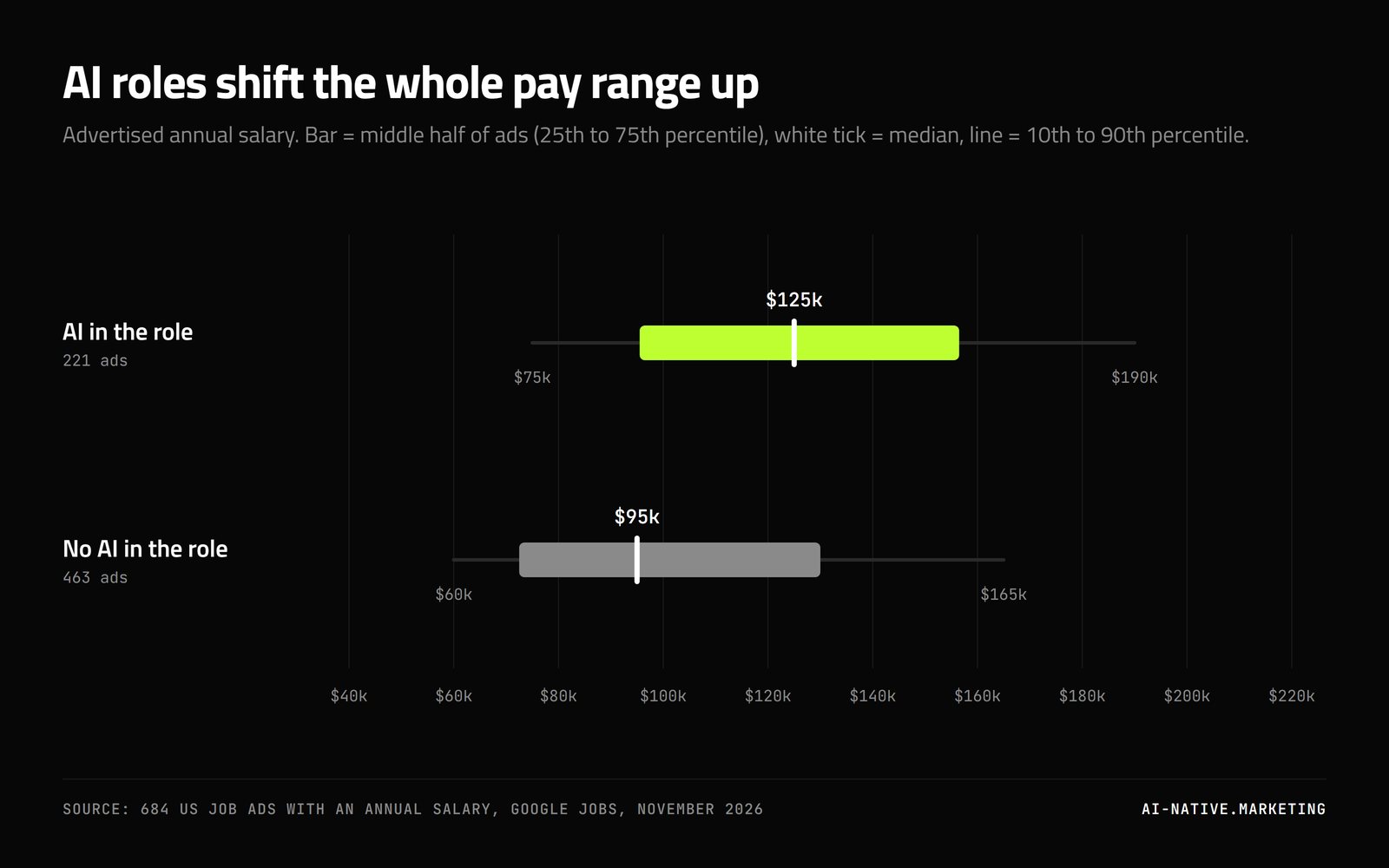
| Advertised annual salary | AI in the role | No AI in the role |
|---|---|---|
| Ads with a salary | 221 | 463 |
| 10th percentile | $75,000 | $60,000 |
| 25th percentile | $95,500 | $72,500 |
| Median | $125,000 | $95,000 |
| 75th percentile | $156,500 | $130,000 |
| 90th percentile | $190,000 | $165,000 |
| Share advertising $150,000 or more | 34% | 16% |
| Share advertising under $75,000 | 9% | 27% |
One in three AI ads advertises $150,000 or more, twice the rate of ads without AI. At the other end, more than a quarter of non-AI ads sit under $75,000, against fewer than one in 10 AI ads. Asking for AI has become a marker of the better-paid half of the market.
Like for like: the premium after seniority
Part of that $30,000 gap comes from the kind of role that asks for AI. AI-asking ads lean senior and lean toward technology companies, and both pay more on their own. So we compared AI and non-AI ads at the same level of seniority, and then inside the same job title.
We sorted every ad into a seniority level from its title: entry (coordinator, associate, junior), mid-level (most manager, specialist, and strategist roles), senior (senior, lead, principal), and leadership (head, director, VP).
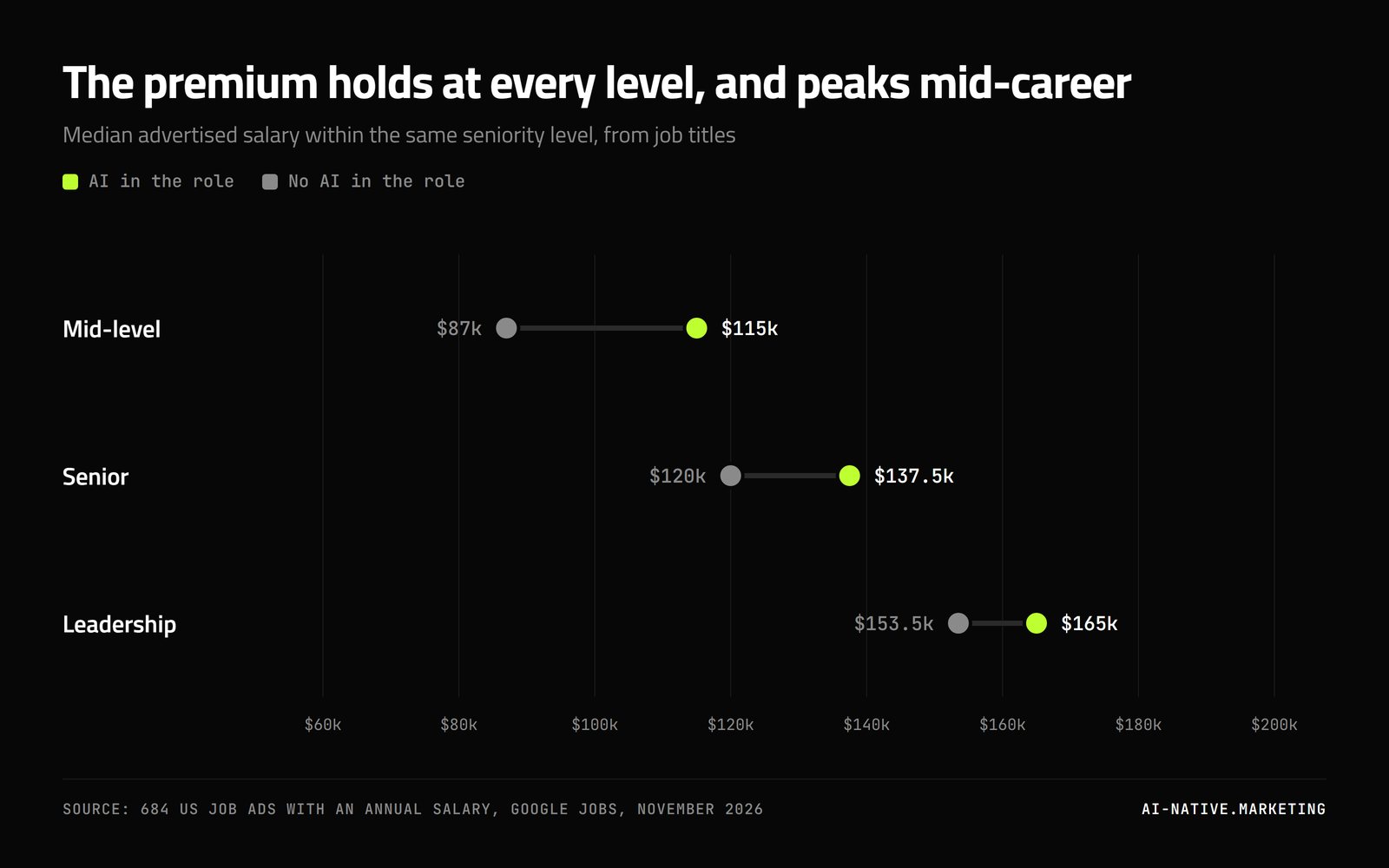
| Seniority level | AI in the role | No AI in the role | Premium | Ads (AI / no AI) |
|---|---|---|---|---|
| Mid-level | $115,000 | $87,000 | +$28,000 | 144 / 309 |
| Senior | $137,500 | $120,000 | +$17,500 | 49 / 78 |
| Leadership | $165,000 | $153,500 | +$11,500 | 25 / 51 |
Only three entry-level ads with a salary put AI in the role, too few to measure, which matches the low rate of AI asks in junior ads in chapter 6.
The premium holds at every level we could measure. Averaged across levels, AI ads advertise about $23,500 more, or 25%. Inside the same job title, across the 25 titles with at least three ads on each side, the premium is about $18,500, or 18.5%. So roughly 60% to 80% of the raw $30,000 gap survives a like-for-like comparison. That's the number to plan with.
The premium is largest mid-career. A mid-level marketer whose job includes AI advertises at $115,000, against $87,000 without it, a gap of a third. At that level, AI changes how much one person can ship. At leadership level pay is set mostly by scope and team size, and the premium narrows to about 7%.
By role group and level
The mid-level premium shows up in every function. Above mid-level, marketing and GTM keep it, and content loses it.
| Median advertised salary | Mid-level, AI | Mid-level, no AI | Senior, AI | Senior, no AI | Leadership, AI | Leadership, no AI |
|---|---|---|---|---|---|---|
| Content | $100,000 | $75,500 | $96,500 | $97,500 | $167,500 | $160,500 |
| Marketing | $132,500 | $105,000 | $152,500 | $134,000 | $155,000 | $144,000 |
| GTM | $129,000 | $87,500 | $165,000 | $137,500 | $195,000 | $152,000 |
Mid-level content roles with AI advertise $24,500 more than those without, the clearest premium in content. Senior content roles show none. GTM carries the largest premium at every level, though the GTM leadership figures rest on 13 ads and work as a signal only.
What each title pays
The best-paid titles in our sample are product marketing managers and GTM engineers, both at a median of $152,500, followed by marketing directors and AI marketing managers at $145,000. At the other end, sales development representatives advertise a median of $64,000.
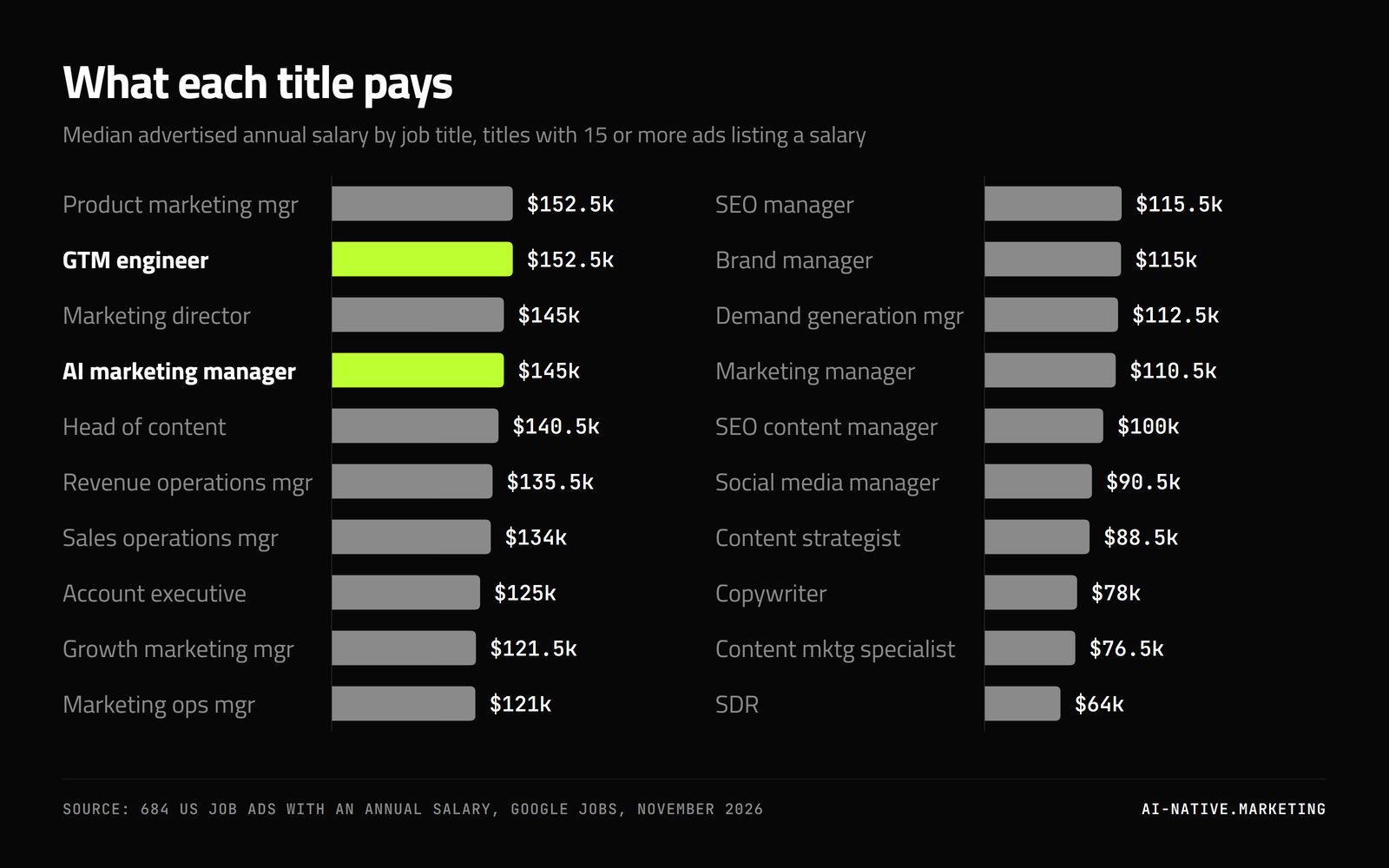
Two of the top four titles are AI-native roles that barely existed in job ads two years ago. The GTM engineer, which went from 0.2% to 4.6% of GTM operations ads in two years (chapter 7), already pays like a product marketing manager.
Inside each title, the AI premium varies a lot:
| Job title | AI in the role | No AI in the role | Difference | Ads (AI / no AI) |
|---|---|---|---|---|
| SEO content manager | $121,500 | $82,500 | +$39,000 | 12 / 11 |
| SEO manager | $119,000 | $86,500 | +$32,500 | 14 / 7 |
| Field marketing manager | $134,500 | $110,000 | +$24,500 | 6 / 11 |
| Demand generation manager | $129,000 | $105,000 | +$24,000 | 14 / 11 |
| Product marketing manager | $162,000 | $140,000 | +$22,000 | 9 / 10 |
| Marketing manager | $125,000 | $104,000 | +$21,000 | 8 / 18 |
| Marketing director | $165,000 | $144,000 | +$21,000 | 7 / 14 |
| Revenue operations manager | $153,000 | $134,000 | +$19,000 | 11 / 16 |
| Content strategist | $99,000 | $82,000 | +$17,000 | 11 / 20 |
| Growth marketing manager | $135,000 | $121,500 | +$13,500 | 8 / 10 |
| GTM engineer | $161,000 | $150,000 | +$11,000 | 21 / 11 |
| Marketing operations manager | $125,000 | $117,000 | +$8,000 | 5 / 19 |
| Copywriter | $78,000 | $78,000 | $0 | 7 / 24 |
| Content marketing manager | $100,000 | $105,000 | -$5,000 | 8 / 7 |
| Head of content | $127,500 | $141,000 | -$13,500 | 9 / 21 |
| Business development representative | $56,000 | $70,000 | -$14,000 | 8 / 15 |
Most cells hold fewer than 20 ads, so treat single rows as indicative. The pattern across the table is the useful part.
Where AI pays, and where it doesn't
The premium is biggest where AI changes what the job is. SEO roles top the table, with SEO content managers and SEO managers advertising $32,500 to $39,000 more when AI is in the role. That's the AEO shift from chapter 10 showing up in pay: an SEO who can win citations in ChatGPT and AI Overviews is doing a bigger job than one who optimises for blue links. Demand generation, field marketing, product marketing, and revenue operations follow, all roles where AI runs through research, targeting, and operations.
The premium is flat or negative where AI is a drafting aid or a volume tool. Copywriter ads pay the same with or without AI. Content marketing manager and head of content ads with AI advertise slightly less, and so do business development representatives. These are small samples, so we read them as showing no premium at all. The message is still clear: pay follows the AI that changes what a role delivers, and faster drafting on its own leaves pay where it was.
GTM engineers show a smaller premium inside the title, $11,000, because nearly every GTM engineer ad asks for AI. When AI is the job, the premium is already baked into the title's median of $152,500.
Builders earn the most
Ads that ask candidates to build with AI pay the most of all. Ads that want someone to build agents, automated workflows, or AI systems advertise a median of $143,500. Ads that ask for AI tool use without building advertise $118,000, and ads without AI advertise $95,000.
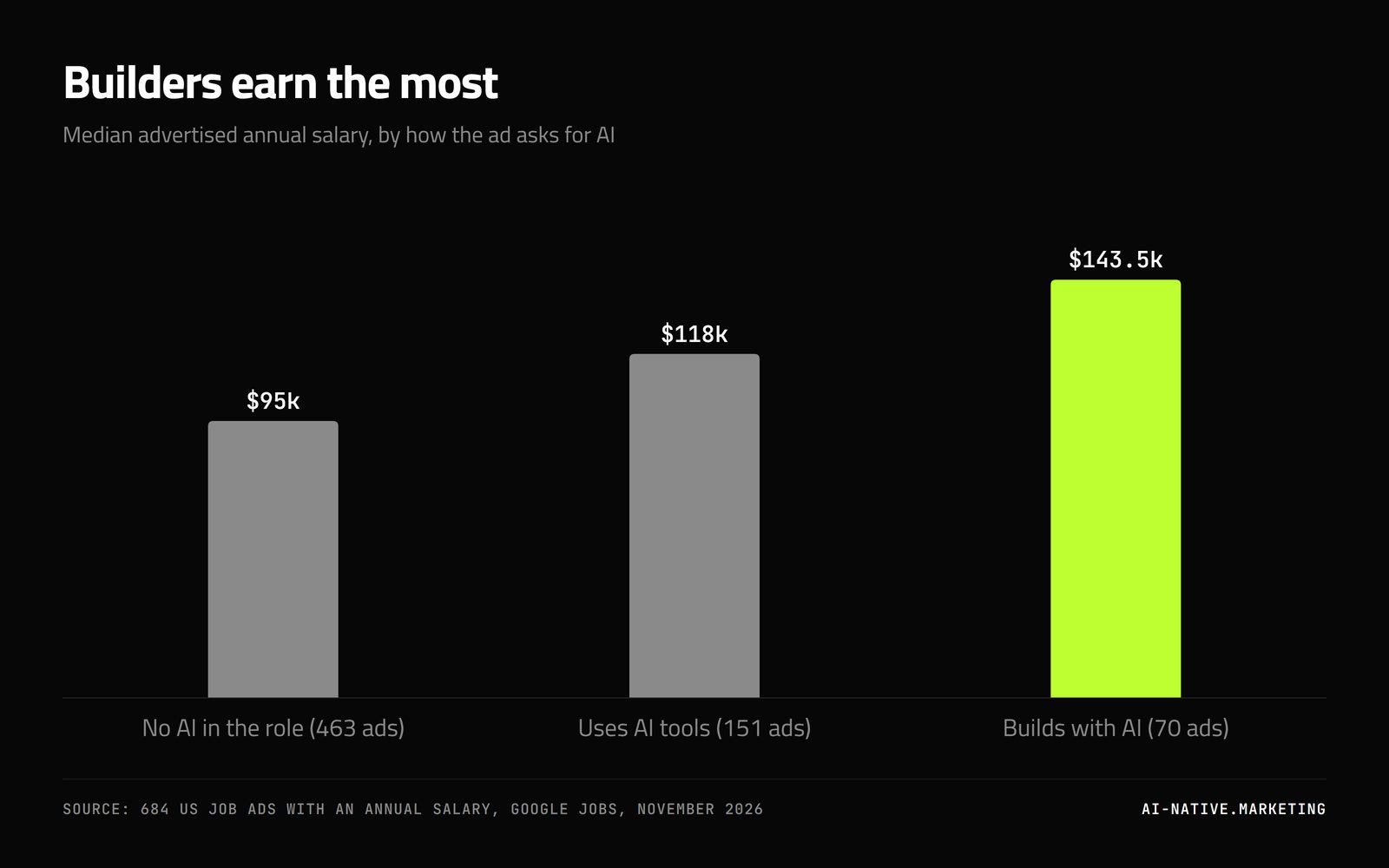
| How the ad asks for AI | Ads | 25th percentile | Median | 75th percentile |
|---|---|---|---|---|
| Builds with AI | 70 | $107,500 | $143,500 | $168,000 |
| Uses AI tools | 151 | $90,000 | $118,000 | $150,000 |
| No AI in the role | 463 | $72,500 | $95,000 | $130,000 |
The builder premium holds within seniority where there's enough data. At mid-level, builder ads advertise $135,000 against $110,000 for tool-use ads (45 and 99 ads). At leadership level the gap is wider, $190,000 against $152,500, on a smaller base of 25 ads. Senior roles run the other way, $127,500 against $137,500, on 49 ads, which we read as noise in a small group.
Each step up the ladder, from no AI to using AI to building with it, adds roughly $25,000 to the median advertised salary. If you're deciding what to learn next, that's the most direct line in this data between a skill and pay.
Remote roles pay a little more
Remote ads with a salary advertise a median of $110,000, against $100,000 for on-site ads (208 and 476 ads). Remote roles also ask for AI more often (chapter 6), so part of that gap is the AI premium travelling with them.
By role group
| Median advertised salary | AI in the role | No AI in the role | Ads with salary |
|---|---|---|---|
| All roles | $125,000 | $95,000 | 684 |
| Marketing | $137,500 | $107,500 | 213 |
| Content | $105,500 | $83,500 | 289 |
| GTM | $140,000 | $105,000 | 182 |
How to read these numbers
- These are advertised ranges. We took the midpoint of each ad's advertised annual range. Advertised pay isn't the same as the offer someone accepts.
- Seniority comes from the title. We sorted ads by the words in their titles, which is a good guide and an imperfect one. A "marketing manager" at a 10-person company and at a global brand sit in the same level here.
- No adjustment for location or industry. Tech companies and big-city roles pay more and ask for AI more, and our like-for-like figures only control for seniority and title.
- Small cells. Rows with fewer than 20 ads are indicative. The overall, seniority, and builder figures rest on hundreds of ads and are the ones to quote.
For context, the median annual wage for US marketing managers was $166,790 in May 2025, across about 421,600 jobs, and the Bureau of Labor Statistics projects marketing manager employment to grow 7% from 2025 to 2035. The jobs are still there. The description is what's changing, and so is what it pays.
Search is rewriting the content job

Answer engine optimisation has moved into the content job description. 11.1% of US content marketing ads mentioned AEO, GEO, or AI search in our 2026 window, up from 4.7% in 2025 and 0.1% in 2024. Across all marketing ads the figure is 3.2%.
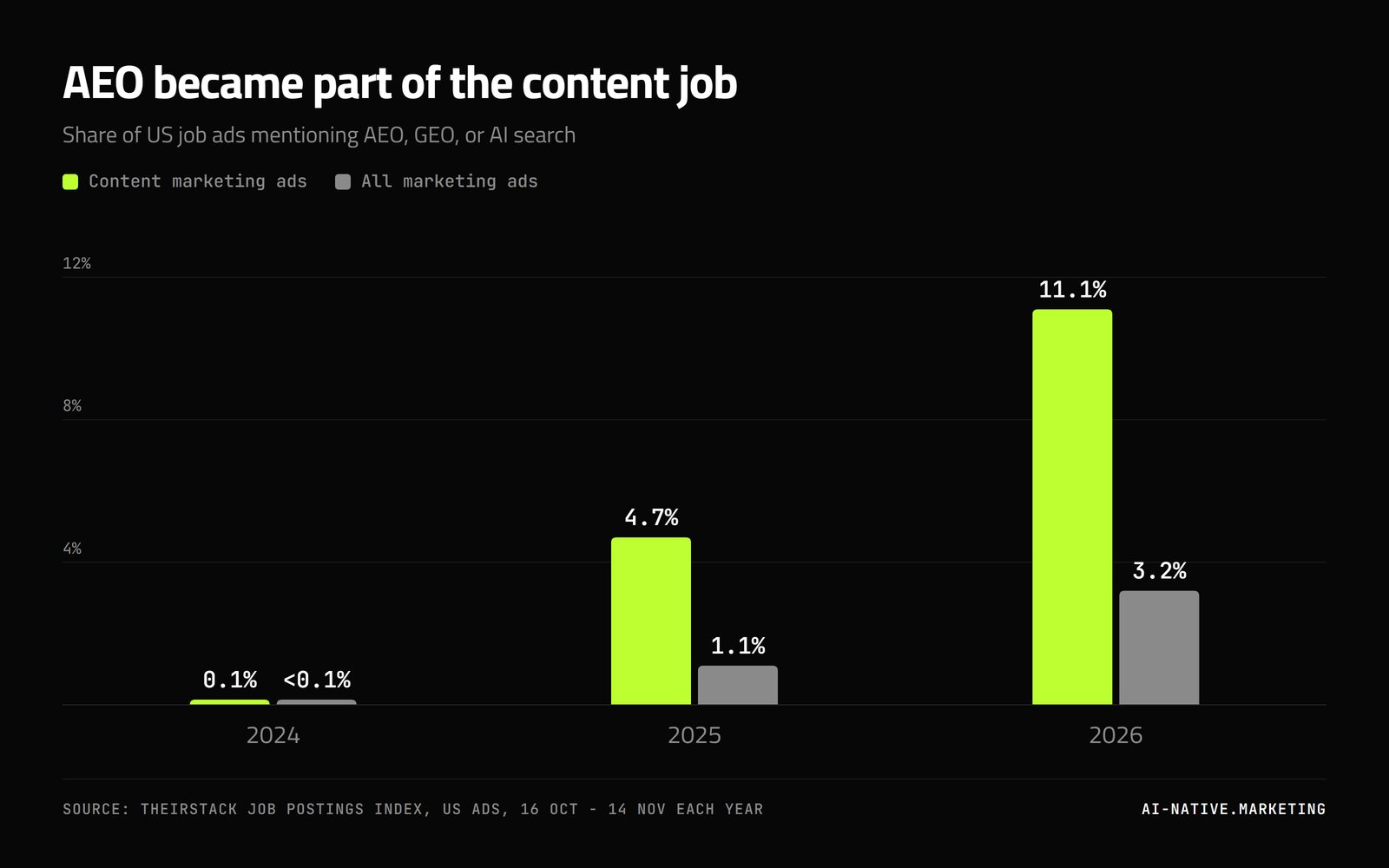
In our reading sample, 36% of the content ads that put AI in the role asked for AI search skills. Outside AI and GTM engineering titles, SEO roles carry the highest AI rates: 68% of SEO manager ads and 55% of SEO content manager ads.
The ads treat it as part of the normal search job:
Develop our approach to SEO and AEO/GEO across Google, ChatGPT, Claude, Perplexity, Gemini, Reddit, YouTube, and whatever comes next.
Fairmarkit
Run the SEO and AEO program: research what buyers search for and ask ChatGPT, Perplexity, Gemini, and Claude, then structure each piece so it ranks and gets cited.
Cogent Security
Demonstrated experience developing thought leadership content and getting it placed, read, and shared - by people and LLMs alike.
Respondology
Why it's happening
The reason is visible in how people search. In a Pew Research Center study of 68,879 Google searches by US adults, 18% of searches generated an AI summary. When a summary appeared, users clicked a traditional search result in 8% of visits, against 15% when no summary appeared.
If fewer people click, being cited inside the answer becomes the goal. Content teams are the ones who write the pages that answer engines quote, so the requirement lands on their job ads first.
What this means

The ads tell you what employers screen for. Use them as a brief.
For marketing leaders
- Write down what AI fluency means on your team. The ads that work name the job AI does in the role: research, drafting, reporting, outbound, or building workflows. "Experience with AI tools" screens for nothing.
- Hold yourself to the standard first. Senior roles carry the highest AI expectations in the ads. If you set the AI expectations for a team, expect to be asked how you use AI yourself, and what you decided to keep human.
- Fund the builders. The GTM engineer is the first mainstream AI-native role in go-to-market. Expect the same pattern in marketing operations and content within a year: one person who builds the systems the rest of the team runs.
- Keep the stack. AI was added to Excel, HubSpot, Salesforce, Canva, and Google Analytics, without replacing them. Plan for people who connect AI to the tools you already pay for.
For hiring managers
- Ask for evidence. The strongest ads ask for a workflow the candidate built and what it changed. Do the same in the interview, and ask to see it.
- Test judgement as hard as speed. Give candidates an AI draft and ask them to fix it. The quality-control half of the job is the half AI can't do.
- Match the AI ask to the function. Content roles need creation, AEO, and editorial judgement. GTM roles need builders. Marketing roles need fluency plus analysis. One generic AI line for every role misses all three.
- Look at your junior pipeline. Only 13% of entry-level ads put AI in the job. If your juniors are expected to use AI from day one, say so, and train them on how your team uses it.
For practitioners
- Name your tools and what you do with them. "Claude for research briefs, n8n for lead routing" beats "AI-savvy" on every ad in this sample.
- Show one thing you built. A workflow, an agent, an automation. Before and after, with the time it saved and the result.
- Show your edit. Bring an example where you threw out what the AI made and explain why. That's the judgement half of the requirement, on one page.
- Learn one builder tool. Zapier, n8n, Clay, or Claude Code. GTM ads name them, and marketing ads are starting to.
- If you work in content or SEO, learn AEO properly. It's in one in nine content ads and two in three SEO manager ads.
What we expect in 2027

These are our expectations, based on the trends in this report. We'll check them against next year's data.
- AI skills in a fifth of marketing ads. At the pace of the past two years, the share of US marketing ads asking for AI skills passes 20% during 2027. Content passes 40%.
- Named tools fade, again. As AI becomes assumed, we expect named AI tools to plateau in ads the way Google Workspace did, while the capability language ("build", "automate", "evaluate") keeps growing.
- Builder roles spread from GTM to marketing operations and content. Expect more titles like content engineer, marketing engineer, and AI operations lead, and more marketing ads naming Clay, n8n, and Claude Code.
- Junior roles catch up. The gap between senior (41%) and entry-level (13%) ads is too wide to last. As AI becomes part of onboarding, junior ads will name it.
- AEO becomes standard in SEO hiring. AI search skills move from a differentiator to a default line in every SEO and content ad.
Method and limits
Data sources
TheirStack job postings index. We used TheirStack's index of job postings, which collects ads from company career sites and job boards and removes duplicates. We queried it on 15 November 2026 for US ads, by job title and by description keywords. Each count returns the total number of matching ads in the window. We ran 208 counts in total.
Google Jobs reading sample. We pulled 2,136 ads from Google Jobs results through SerpApi on 15 November 2026, across 39 job titles, then removed duplicates by title and company to keep 1,905 unique ads. Google Jobs returns each ad's description and, for most ads, a split into qualifications, responsibilities, and benefits. 1,490 of the 1,905 ads had a qualifications section.
Windows
The year-on-year comparison uses 16 October to 14 November in 2024, 2025, and 2026. The quarterly series uses calendar quarters from January 2025 to September 2026, plus 1 October to 14 November 2026. Seniority, company size, and remote cuts use the 2026 window.
Matching
We matched job titles and description keywords as described in "About this research". Keyword matching is blunt. "AI" also catches lines like "experience at an AI company", which is why we report how many mentions sit in the qualifications and responsibilities, and how many are hard requirements, next to the broad counts.
The eight categories in chapter 4 come from pattern matching on the AI-related lines in each ad's qualifications and responsibilities. A line can fall into more than one category.
Limits
- Ads show intent. A job ad shows what an employer asks for. It doesn't show who they hire, what the person does day to day, or how the employer checks the requirement.
- The index grows each year. Raw volumes aren't comparable across years, so we compare shares only.
- The reading sample is search-ranked. Google Jobs returns the ads it ranks highest, which tilts toward larger job boards (Indeed, LinkedIn, ZipRecruiter) and a media and content jobs board, Mediabistro, which supplied 15% of the ads. Content roles make up 47% of the sample, so we report every sample figure by role group and never pool them without saying so.
- Salaries. Only ads with an annual salary range count. Medians aren't adjusted for seniority, location, or industry.
- Seniority in chapters 6 and 9 comes from the words in each job title in the reading sample. Company size comes from the index's own classification. 8,096 of the 41,734 marketing ads in the 2026 window had no company size, and they're excluded from that cut.
- Tool names with other meanings. "Jasper" also matches place and person names, "Gemini" matches a crypto exchange, and "Clay" matches materials companies. These add a little noise to the smallest tool counts and don't change any finding.
- Descriptions got longer. Job descriptions have grown over the two years, which raises keyword matches slightly on its own. The stricter AI-skills list and the qualifications check limit the effect.
- The provider outage. Our job-index provider stopped answering partway through the re-run on the stricter AI-skills list. The headline figures by year use the stricter list. The quarterly trend and the company-size cut use the broader list, and we say so wherever they appear.
- US only. We didn't study other countries.
Appendix: data tables
A1. US job ads by role group and year (16 October to 14 November)
| Role group | 2024 ads | 2025 ads | 2026 ads |
|---|---|---|---|
| Marketing | 36,325 | 27,886 | 41,734 |
| Content | 3,139 | 2,188 | 3,571 |
| Sales | 41,960 | 37,833 | 71,265 |
| GTM operations | 3,290 | 3,850 | 7,733 |
A2. Share of ads by measure, role group, and year
| Measure | Group | 2024 | 2025 | 2026 |
|---|---|---|---|---|
| AI mentioned | Marketing | 6.8% | 16.7% | 32.5% |
| AI mentioned | Content | 17.6% | 30.8% | 53.0% |
| AI mentioned | Sales | 7.1% | 13.7% | 26.0% |
| AI mentioned | GTM operations | 12.5% | 30.7% | 53.9% |
| AI skills | Marketing | 0.8% | 5.1% | 14.8% |
| AI skills | Content | 3.4% | 14.5% | 31.2% |
| AI skills | Sales | 0.4% | 2.1% | 6.8% |
| AI skills | GTM operations | 0.9% | n/a | 22.4% |
| AI-skills language, broad | Marketing | 0.9% | 5.9% | 16.4% |
| AI-skills language, broad | Content | 3.2% | 14.3% | 26.6% |
| AI-skills language, broad | Sales | 0.5% | 3.5% | 10.5% |
| AI-skills language, broad | GTM operations | 1.0% | 11.6% | 29.2% |
| AI tools named | Marketing | 0.4% | 2.0% | 5.1% |
| AI tools named | Content | 1.0% | 6.0% | 8.6% |
| AI tools named | Sales | 0.4% | 0.5% | 1.6% |
| AI tools named | GTM operations | 0.7% | 3.2% | 10.0% |
| Google Workspace | Marketing | 2.1% | 3.3% | 3.0% |
| Google Workspace | Content | 2.7% | 4.2% | 3.7% |
| Google Workspace | Sales | 0.9% | 1.4% | 1.3% |
| Google Workspace | GTM operations | 3.3% | 7.9% | 6.3% |
| AEO | Marketing | 0.05% | 1.1% | 3.2% |
| AEO | Content | 0.1% | 4.7% | 11.1% |
A3. Quarterly share of ads with AI-skills language (broad measure)
| Quarter | Marketing ads | Marketing share | Content ads | Content share |
|---|---|---|---|---|
| Q1 2025 | 116,549 | 1.5% | 9,865 | 5.0% |
| Q2 2025 | 84,755 | 3.0% | 7,780 | 9.0% |
| Q3 2025 | 81,959 | 4.6% | 7,022 | 11.0% |
| Q4 2025 | 80,121 | 5.9% | 6,755 | 14.1% |
| Q1 2026 | 103,494 | 7.5% | 8,937 | 16.4% |
| Q2 2026 | 108,848 | 11.3% | 9,731 | 21.9% |
| Q3 2026 | 117,867 | 13.0% | 10,709 | 20.9% |
| Q4 2026 to 14 Nov | 62,258 | 15.7% | 5,447 | 24.7% |
A4. Claude and ChatGPT over time
| Share of ads | 2024 | 2025 | 2026 |
|---|---|---|---|
| Marketing, Claude | 0.07% | 0.30% | 3.25% |
| Marketing, ChatGPT | 0.26% | 1.36% | 2.30% |
| Content, Claude | 0.29% | 0.91% | 6.36% |
| Content, ChatGPT | 0.67% | 4.98% | 5.07% |
A5. Company size and remote, 2026 window (broad measure)
| Cut | Marketing ads | Marketing AI-skills language | Content ads | Content AI-skills language |
|---|---|---|---|---|
| 1 to 50 employees | 6,351 | 17.7% | 489 | 25.8% |
| 51 to 500 employees | 8,374 | 20.2% | 838 | 29.5% |
| 501 to 5,000 employees | 8,438 | 18.9% | 804 | 25.6% |
| More than 5,000 employees | 10,475 | 14.7% | 890 | 28.3% |
| Remote | 8,131 | 27.6% | 827 | 25.0% |
| All | 41,734 | 16.4% | 3,571 | 26.6% |
A6. Advertised salary by seniority level
| Seniority level | AI ads | AI median | No-AI ads | No-AI median |
|---|---|---|---|---|
| Entry | 3 | $60,000 | 25 | $62,500 |
| Mid-level | 144 | $115,000 | 309 | $87,000 |
| Senior | 49 | $137,500 | 78 | $120,000 |
| Leadership | 25 | $165,000 | 51 | $153,500 |
A7. Reading sample by group
| Measure | All | Content | Marketing | GTM |
|---|---|---|---|---|
| Unique ads | 1,905 | 895 | 550 | 460 |
| AI mentioned anywhere | 40.6% | 37.7% | 44.5% | 41.7% |
| AI in duties or qualifications | 31.0% | 30.5% | 31.6% | 31.3% |
| AI listed as a qualification | 19.6% | 18.8% | 20.2% | 20.7% |
| AI as a hard requirement | 13.4% | 11.8% | 13.8% | 15.9% |
| AI in the role, remote ads | 40.7% | 42.0% | 34.7% | 47.7% |
| AI in the role, on-site ads | 28.2% | 26.9% | 30.8% | 27.8% |
Sources
Proprietary data: TheirStack job postings index and Google Jobs (via SerpApi), US job ads, collected 15 November 2026 by AI Native Marketing.
Public sources, opened 15 November 2026:
- Bureau of Labor Statistics, Advertising, promotions, and marketing managers, Occupational Outlook Handbook
- Content Marketing Institute, B2B content and marketing trends research
- HubSpot, AI trends for marketers report
- Indeed Hiring Lab, January labor market update: jobs mentioning AI are growing amid broader hiring weakness, 22 January 2026
- Lightcast, Four takeaways from the 2026 Stanford AI Index
- LinkedIn, LinkedIn and Adobe launch global AI skills initiative for marketing professionals, 16 June 2026
- LinkedIn, A new world of work: global labor market rotates, not retreats, 14 January 2026
- Microsoft, The 2025 annual Work Trend Index: the Frontier Firm is born, 23 April 2025
- Microsoft and LinkedIn, 2024 Work Trend Index on the state of AI at work, 8 May 2024
- Pew Research Center, Google users are less likely to click on links when an AI summary appears in the results, 22 July 2025
- Salesforce, State of Marketing 2026: 75% of marketers have adopted AI
The site that publishes this report is run by the team that builds Contengi, an AI content platform. Contengi isn't mentioned or ranked anywhere in the findings.