API vs UX Scraping for LLM Tracking - which is more accurate? Here's what the data says.
Newsletter By Stefan Maritz6 min read
A few weeks ago Sara Stella Lattanzio and I published a guide in The Workflow on building your own AI visibility tracker. A small app on Supabase and Vercel sends your brand, category, and comparison prompts to the models, stores every answer, and scores how often you get mentioned and cited. A run costs a few dollars.
We knew this would ruffle feathers among vendors who want you to think their product does something special, and it did, leading to a pretty nifty little experiment I'm happy to share with you today.
Within minutes after posting, this comment popped up....
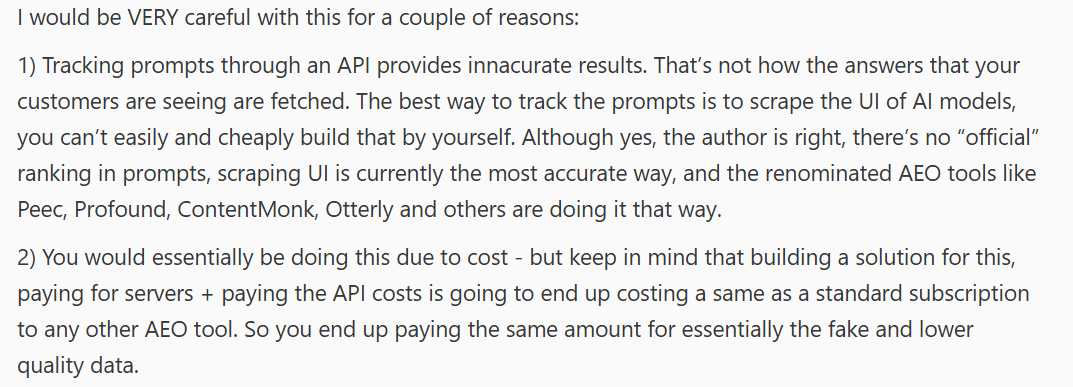
The founder of one of these vendors, ContentMonk, made two points. API answers are not what your customers see in the apps, which is why Peec, Profound, Otterly, and ContentMonk scrape the chat interfaces instead. And once you add servers and API costs, building it yourself costs about the same as a subscription, so you pay the same for worse data.
Both points are fair, and frankly, very testable - and I have done that before, so I knew what I was getting into. But nonetheless, we tested it head-on.
How we set it up
The founder suggested the test and did the heavy lifting on his side. He picked 10 buying-intent prompts across industries and ran each one 10 times through ContentMonk's UI scraping on ChatGPT, Gemini, and Google AI Overviews, from the United States. Then he shared every answer and every source publicly. Credit where it's due, that's how this kind of argument should get settled.
I took his second prompt, word for word: "Best payroll software for a US small business with under 20 employees". Then I answered it four ways, 10 times on each engine:
- DIY from memory, GPT-6 Luna and Gemini 3.5 Flash through the Vercel AI Gateway with web search switched off, plus Google AI Overviews through DataForSEO
- DIY with search, the same models with live web search on
- UI scraping, ContentMonk run
- Manual, me typing the prompt into the real ChatGPT, Gemini, and Google apps and copying out every answer and source (hence why I only worked with one prompt - this would have taken ages if I had to do it 300 times)
That's 120 answers, 110 of them unique, since both DIY setups share the same 10 AI Overviews. Every answer went through the same scorer, ContentMonk's included. It checks which brands get named, which sources get cited, and how close two answers sit in meaning.
If a model with no search at all lands as close to the apps as a scraper does, then live search has very little say in which brands get recommended.
The ultimate finding - nothing agrees with itself
Before you compare methods, you need to know how much one method moves on its own. It moves a lot.
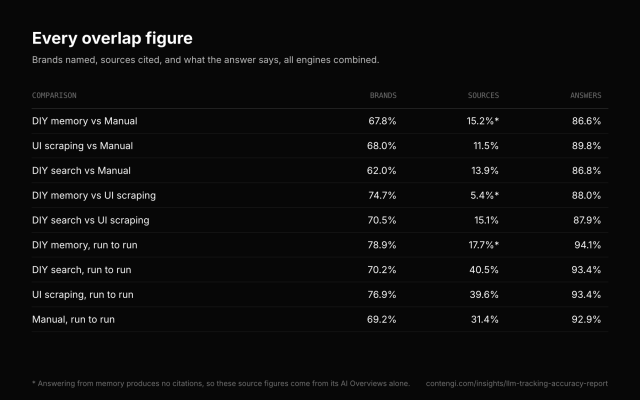
Type the prompt into the apps twice and the brand lists overlap 69.2%. UI scraping repeats itself at 76.9%, DIY with search at 70.2%, and DIY from memory (no surprise here) is the steadiest of the lot at 78.9%.
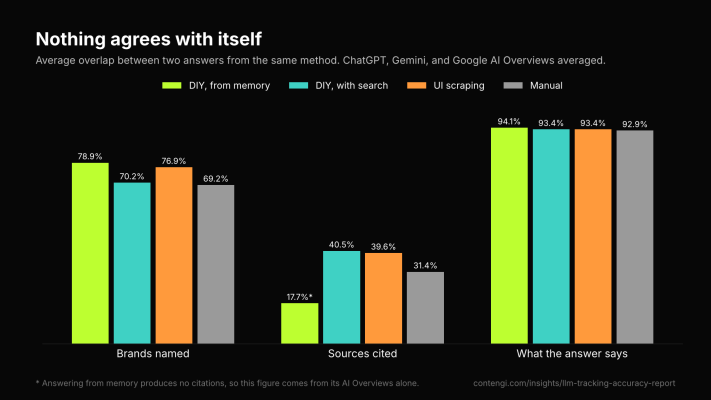
This is the floor every AI visibility number stands on. A tool that shows you one answer per prompt is showing you one roll of the dice, however it got that answer.
The methods sit as far apart as each one sits from itself
On brands, DIY from memory overlapped 67.8% with the hand-typed answers. UI scraping overlapped 68.0%. That's a tie, and both land inside the range a single method moves by itself. DIY from memory and UI scraping overlapped each other at 74.7%, closer than two of my own hand-typed runs got to each other (which makes you wonder if what it's scraping is even the real deal...)
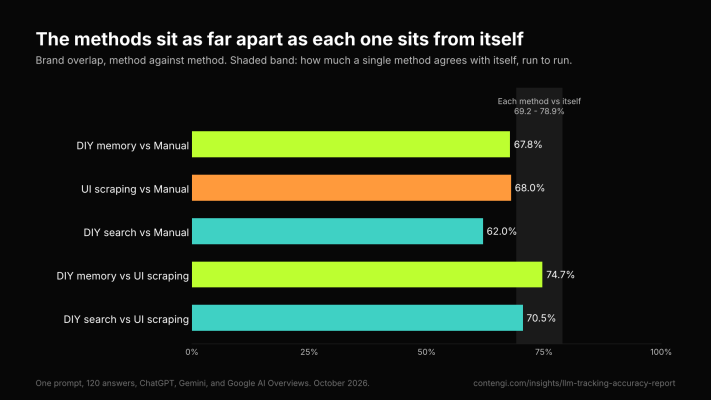
What the answers say lines up too. Every pair of methods lands between 87% and 90% similarity in meaning, a few points under the 93% to 94% you get when one method repeats itself.
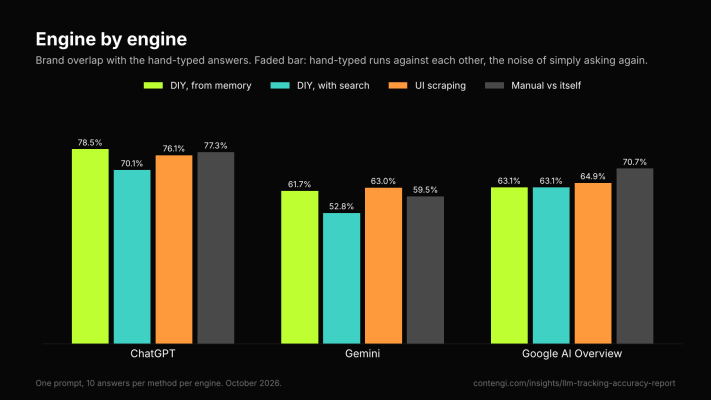
Engine by engine, the picture holds. On ChatGPT, memory-only DIY matched the hand-typed answers best of all, 78.5% against 76.1% for scraping. Gemini was a tie at 61.7% and 63.0%, and Gemini is so jumpy that two hand-typed runs only overlap 59.5%. On AI Overviews, DIY came in at 63.1% and scraping at 64.9%.
The brands that count came out all the same all the time
For a marketer, the question that pays the bills is who gets recommended. For the prompt in test, Gusto and OnPay show up in all 110 unique answers, QuickBooks in 109, Patriot in 90, and Gusto is the first brand named in 102 of them. Every method, every engine, same story and same brands at the top.
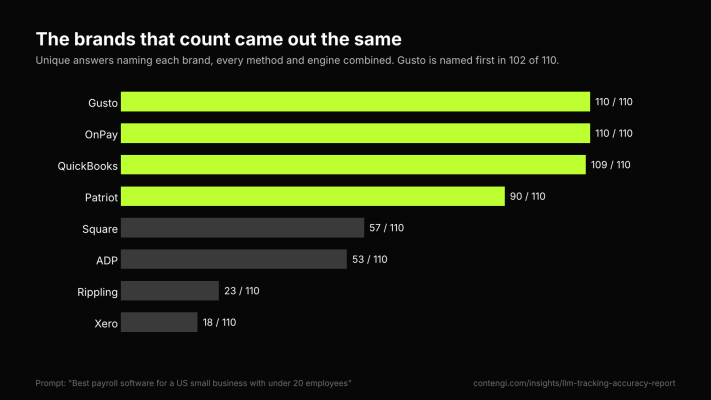
Further down it gets real noisy. Square, ADP, and Rippling drift in and out depending on the engine and the run, which is exactly why one answer per prompt tells you so little about where you stand.
Sources are all over the place for all methods
Cited sources move far more than brands. Two runs of the same method share 31% to 41% of their cited domains, two different methods share 5% to 15%. Where both had sources to compare, DIY landed closer to the hand-typed answers than scraping did, 13.9% against 11.5%.
No amount of money fixes that. Individual cited pages move too much to track one by one, so watch the domains that turn up across many runs and treat single citations as anecdotes.
This wasn't my first run at the experiment either. At Backbase, where we use a DIY setup specifically for brand accuracy, I compared the same DIY setup against AirOps over thousands of answers and found around 80% overlap between the two, with around 70% from one run to the next inside each tool. Two tests, two different paid tools, one conclusion: a simple, easy-to-build DIY tracker and a paid platform disagree with each other about as much as each one disagrees with itself, as much as it disagrees with a real, manual, human search.
What about the cost argument?
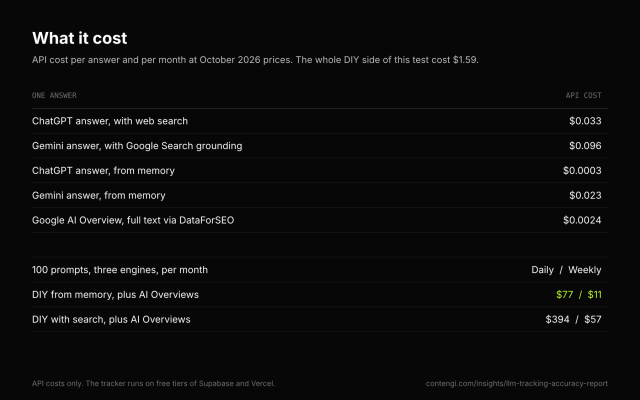
The whole DIY side of this test cost $1.59 in API calls. Scale it to 100 prompts across three engines and answering from memory costs $77 a month run daily, or $11 run weekly. With live search on, it's $394 daily and $57 weekly. Search is where the money goes, Gemini's Google Search grounding most of all, because it bills per search and runs about five searches per answer. The tracker itself sits on free tiers of Supabase and Vercel.
I'll leave the subscription maths to you, you know what you're paying. The quality argument for paying more is a lot weaker than it sounds.
What I suggest you do with this
If you need to know where you are showing up, if you get cited and what gets said about your brand is accurate, build your own. You own the data, you pick the prompts, and you can score answers against your own knowledge base for accuracy as well as visibility.
That last part is why I built one at Backbase in the first place. ChatGPT recommended us in almost every query we cared about, but what it said about us was wrong or outdated, and no dashboard I could buy tracked that.
Then run it like this:
- run every prompt several times and report the share of runs that name you, never a single answer
- start with memory-only runs for brand perception, and add search when you need citations, since search is where the bill comes from
- run it weekly or every two weeks, because two runs of the same method only share 69% to 79% of their brands and a daily chart mostly shows you that noise
- track the domains that turn up across many runs, and stop worrying about individual cited pages
- type your five most important prompts into the apps by hand once a month, it takes 20 minutes and tells you whether your tracker still lines up with what people see
Big thanks to the team over at ContentMonk for putting his data on the table.
The original guide on The Workflow: theworkflow.digital/p/build-your-own-ai-visibility-tracker
This article was written using a transcript and original research data running through a agentic workflow on Contengi.com
More newsletter
Issue 3: Hydrogen, Business Hub, and a change log for November
Hydrogen in AI Mode, Business Hub counts, Meta's Muse agent, a change log for your November numbers, Exa from the stack, and a free publication template.
Newsletter · 3 min
Issue 2: your AI visibility score meets a placebo test
One site's AI click share, Brave's index in court, Cloudflare's crawl hints, a placebo test for your AI visibility score, the ai-seo skill, and a free knitwear template.
Newsletter · 3 min
Issue 1: the week chat ads met their spreadsheet
Chat ads meet real conversion data, the first loop worth handing to an agent, a copywriting skill with 247,000 installs, and a free fintech template.
Newsletter · 2 min